

[Week 40/52]: YOUR XR Opinion matters a lot. Thank you so much to @NyanBlade (founder of StageTime VR), and a second VR developer who requested they remain anonymous.
[TOPIC]: Two VR insiders tried the Meta VR glasses last week! And, this is what they thought:
[Week 40/52]
Two VR insiders tried Meta’s VR glasses. Here’s what they thought.
This week, we hear from two VR developers who tried Meta’s VR glasses last week: Hamza Qureshi (@NyanBlade), founder of Virtuware and creator of StageTime VR, and an XR insider from our Spatial Collective community who requested anonymity.
Thank you to both for sharing their hands-on impressions.
Interview #1: Hamza Qureshi (@NyanBlade)
Founder of Virtuware • Creator of StageTime VR
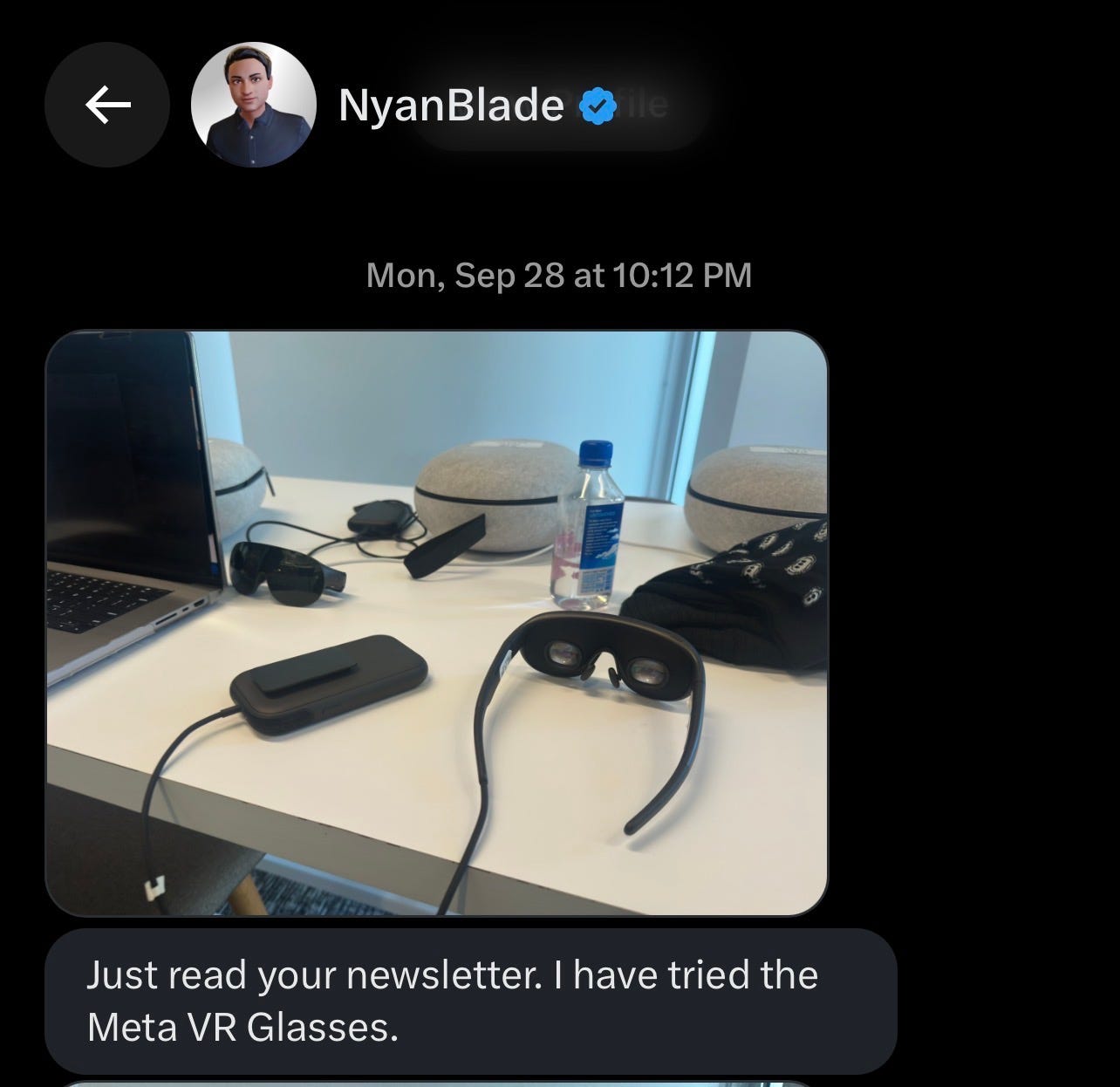
Hamza Qureshi is the founder of Virtuware and creator of StageTime, a social VR app for karaoke, comedy, open mic nights and hanging out. Previously a software engineer at VRChat, he’s been building social VR experiences since 2017. His focus is on making VR a place people come back to for the community and shared experiences.
I’m not his investor. But I’m a supporter! And so thankful for his thoughtful and kind response. So PLEASE! Explore his business: stagetimevr.com
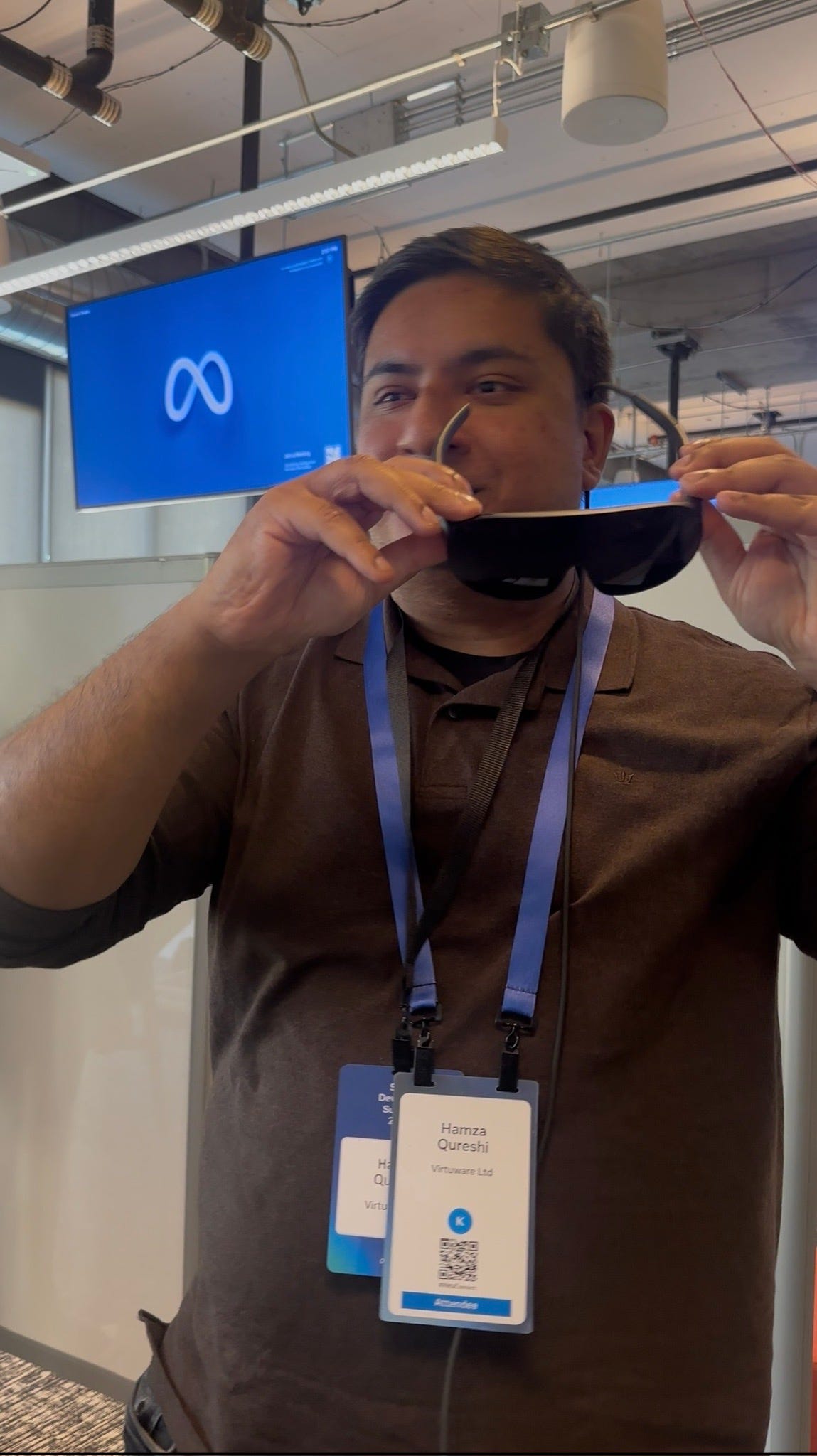
Hamza wrote this for us:
“Hey Don! Positives: It’s the first VR device I’d actually refer to as glasses. They were much smaller than I expected and so lightweight I could hardly feel them on my face. I tried them sitting and standing, and the cable and compute puck didn’t bother me at all.
The micro-OLED displays looked much nicer to me, and the overall experience felt easier on my eyes. I’d want more time before judging comfort over longer sessions, but my first impression was very positive.
The biggest benefit for me is portability and how easy they are to put on and take off. These feel like something I’d look forward to using and could carry with me every day, especially when travelling.
I would personally buy them at $1,300. I’d want to use them as my main device for development. Being able to build and test wherever I am, with less friction, is a big deal. I can also see using them more naturally leading me to develop more for the platform.
Negatives:
The field of view felt noticeably smaller than Quest 3. For mixed reality content it wasn’t so much of an issue as you can see the real world outside the frame. For full VR it felt more restrictive, although I adjusted quickly. I’d primarily be buying these for work, cinema and travel.
While I see the value personally, I’m less certain about mainstream appeal at $1,300. That’s a pretty significant purchase for someone who isn’t already interested in XR. I think they could be a great device for some people, but the everyday reasons to buy and keep using them will need to be compelling.
Unknowns:
Software reliability is my biggest question. With my own Quest, I end up restarting it at least once every day I use it, and every OS update introduces new bugs. That’s my experience with Quest, rather than a verdict on these glasses, but I’d need a more dependable experience to rely on them for daily work. The hardware is attractive enough to make me want to use them.
On battery, I believe it’s expected to last up to twice as long as Quest 3.
Content is another question. Meta has announced more than 75 apps/games that support hand tracking at launch, alongside its media offering. That’s a starting point, but the important thing is whether there are enough useful apps and experiences to keep people coming back. I’m not sure yet.
Overall, I came away wanting a pair. The size and comfort make a real difference to how often I can imagine using them. I still have questions about software and the wider audience, but personally, these feel like something I’d enjoy having with me and using regularly.
Interview #2:
An Anonymous Spatial Collective Insider ❤️
Meta VR Glasses — Early Hands-On Q&A
One of our Spatial Collective members was able to try a prerelease version of Meta’s VR glasses and shared the following reaction anonymously.
Q: Thank you for sharing your experience with Meta’s VR glasses. Before we jump into some Q&A, could you share your overall thoughts on how this new release will influence the market? Will VR finally be ready for the mainstream? Or will the price put it out of reach?
My pleasure. I’ve enjoyed being a part of the Spatial Collective community and feel passionate about developing in this space and supporting those who continue to fight the good fight. We all know it’s not easy developing on the frontier. Hopefully, I can provide some useful information that isn’t just influencer hype or marketing BS. Just an FYI: I can only provide my thoughts on the features they announced, not on everything I experienced.
Overall, I think this upcoming release of Meta’s VR glasses will have a bigger influence on the trajectory of VR adoption than any release prior. Meta’s messaging, features, and most definitely the form factor combine to take a major step forward in a way that feels more legitimate and less toy-like (not that that’s a bad thing).
Is $1,300 too much? No. At this price point it’s positioned in the premium device realm (prosumer). I didn’t know the retail cost when I tried the device, but when they announced the price, I was honestly shocked it was that low. Look, gone are the days of heavily subsidized hardware. Add the chip and material shortages in the market, tariffs, and you could easily price this above $2k.
Will this be the device that accelerates the hockey-stick curve of adoption? I don’t know. However, I do think this is the way to get there. Meta carries over its large content ecosystem, spatial UI, developer tools, and more, which sets it up for a release more like an iPhone than a gaming console. For prosumers, I’m confident they’ll find this to be an easy and even surprisingly useful addition to their digital lives.
Q: What was your immediate reaction when you first saw the Meta VR glasses?
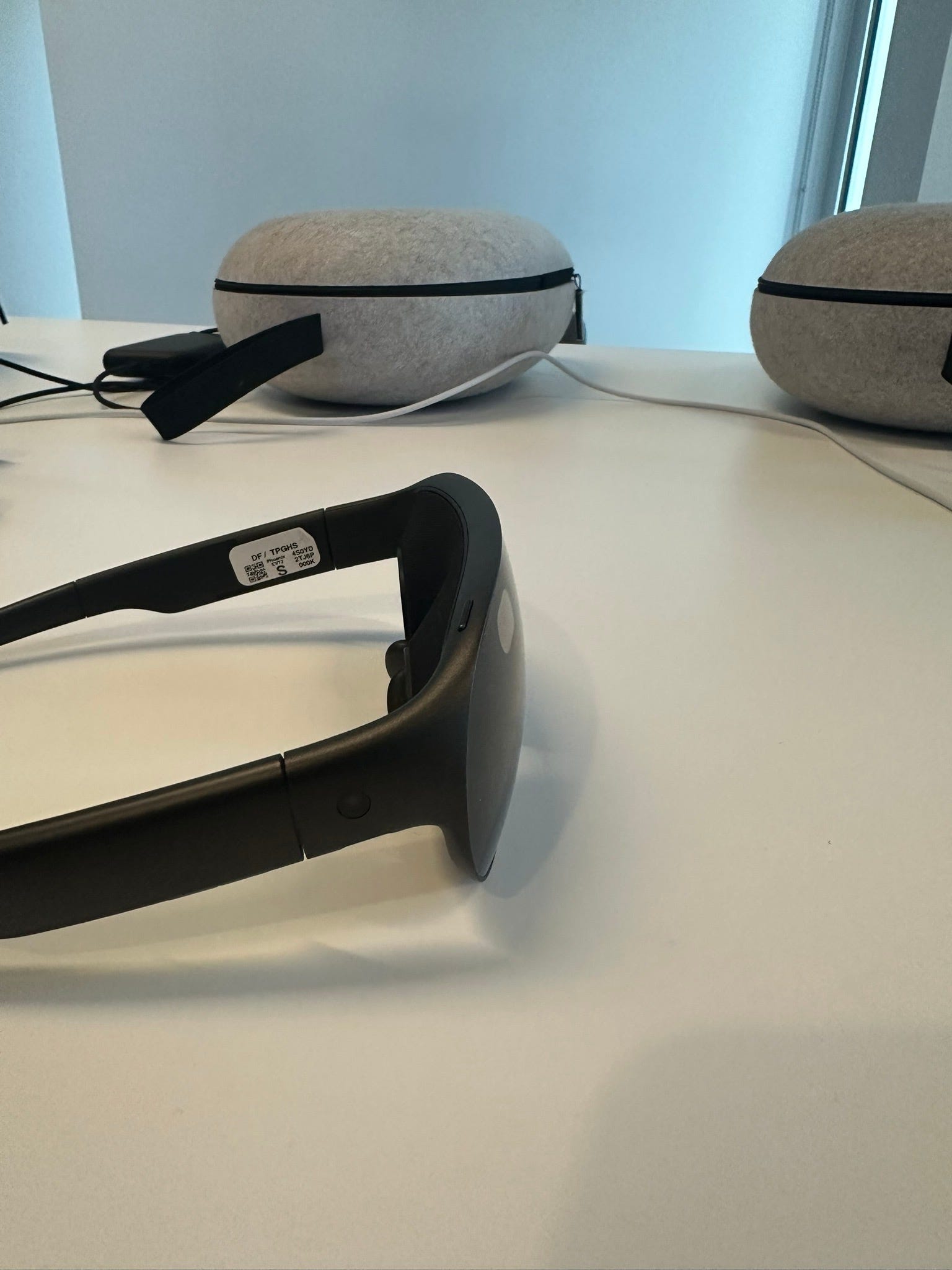
My first reaction was intrigue and excitement. I didn’t immediately know what to expect because the design is a major departure from typical VR headsets. To the casual observer, the only clue these could be display glasses was the tether. Otherwise, I would have thought they were just an oversized pair of glasses, like ’90s rock-star Bono bug-eye sunglasses.
Q: Did they feel like glasses when you first put them on, or did they still feel like a VR headset?
They fit like regular glasses, unlike the experience of strapping a VR headset to your face. Certainly, Meta’s VR glasses are built for all-day comfort. Super light. Easy on and off. Something that no other device, especially Apple, could claim.
I was surprised the VR glasses are lighter than my own eyeglasses. No joke. It was almost off-putting when I picked them up. The voice in the back of my mind was like, there’s no way these could be quality because they feel too light.
There was a quick calibration setup for eye tracking, then a series of hand-gesture exercises. Overall, first impressions were good and easy enough for anyone to perform.
Do not underestimate the form factor and ease of fit. Vanity has been a huge barrier for most people. For so many years I have seen people put off by the idea of having to strap a brick on their heads…not to mention sharing a headset with someone else!
Q: How was the experience?
I was able to use the Meta VR glasses for about an hour. At no time during that experience did I encounter even an ounce of discomfort. I could absolutely imagine using these throughout the day for a variety of reasons: productivity, entertainment, gaming, relaxing, and even just browsing the web or reading.
The device immediately started in passthrough mode. The display FOV was adequate and responsive. I wouldn’t say the VR glasses’ FOV was as immersive as some other VR headsets, but it also didn’t bother me. It’s good. I did have a few visual glitches in my demo, but I would be confident any glitches would be ironed out before shipping.
The display is good: bright display, and good color. Eye tracking combined with simple gestures makes it easy and intuitive to control. You don’t need to make any wild hand gestures to navigate the UI. The quality and reliability of hand tracking and gesture recognition were solid. I could reliably control the UI with subtle movements from various relaxed and natural positions.
I kept thinking to myself that it felt more Apple Vision Pro-like, but way more comfortable.
Q: What was it like watching entertainment or playing games on them?
This was one of the areas I didn’t have time to really explore. I was only using hand controls and didn’t try using physical controllers. Support for physical controllers was mentioned, and I imagined that to mean they would either have new controllers available as an accessory, support existing Quest or gaming controllers, or all of the above. Personally, I wouldn’t mind a slimmed-down version of the controllers to match the ease of use and portability of the VR glasses.
Visually, the display resolution, FOV, and color enhancements make everything look good. To be fair, display enhancements are an expected upgrade. The form factor itself makes watching videos, playing console games, YouTube, or whatever else more accessible. Would goggles make for immersive playing experiences? Probably, but I wouldn’t go as far as to say gaming on glasses will suffer.
I didn’t get a chance to view 3D movies, but I could only imagine this would be a better visual experience than in a theater. That said, I don’t think 3D movies are a compelling use case by themselves.
Q: Will this make VR productivity a thing? Could you imagine working in these glasses for an extended period?
Yes and no. Yes, for people who already find immersive meeting spaces or training useful. No, for people who are already anti-glasses, don’t need to work with others, or find video meetings satisfactory. I think anyone in between those extremes would find this to be a compelling opportunity to experience, because there is a lot to offer here: travel, privacy, connectivity, and so on.
For example: Would this pass the coffee shop test? Walk into a normal coffee shop during the week and you inevitably see tables full of people working on their laptops or browsing on their phones. If several of those people were wearing Meta VR glasses, would you recognize them? Would they stand out? Do you think people would think they look silly? Do you think the wearers would think they look stupid? I would wager the answer is no for all.
Now apply this test to any other normal working environment: trains, planes, co-working spaces, offices, and I think the answer would be the same. No, they don’t look silly, people wearing them don’t stand out, and I don’t feel people wearing them would feel overly self-conscious.
Again, the simplicity of the form factor alone should make it far more accessible to the mass market, which is put off by the traditional strap-on HMD. Add in the improved resolution, comfort, support for DisplayPort, and it should become way more appealing to a wider audience.
Q: Did the separate compute puck bother you?
Not at all. I wouldn’t want to trade for lightness and comfort. I was sitting the entire time I used the device, so the tether and puck were never in the way.
Q: What feels most different from Meta Quest?
The Quest is like a toy (as in focused on fun). The VR glasses feel more serious. It’s not simply that they’re smaller. They really do come across like a premium device, more capable to do more things for more people.
I could see the Quest continue as a budget-friendly line and continue to evolve and improve from the trickle-down of tech. You could also think of the VR glasses as a relaunch of the failed Pro line of VR goggles. The VR glasses are a clear level above Quest in most every way but also seem to target a different market…dare I say an “adult” or “professional” audience. I’ve heard a lot of people say of Quest, “I used it for a while, then gave it to my kid.” I don’t think the VR glasses will suffer the same fate.
Q: What do you think the killer application is? What would make you want to use them every day?
I’m not a big believer in the “killer app” argument. Instead, I think digital devices need to be able to provide a killer experience. They need to support a variety of experiences people actually value and use repeatedly. VR and AR haven’t been in the mass market long enough to know what people may love to use repeatedly. I think the best we could hope for is that VR glasses will become more mainstream and attract more developers to create more diverse experiences.
For me, the threshold for this category isn’t whether the technology is impressive. I expect new iterations of devices to impress. These VR glasses make a strong argument that putting them on becomes easier and more useful than reaching for another screen. I think that’s the really interesting and hopefully compelling idea for people.
Q: What still needs work?
There were a few display glitches, but nothing serious. For the most part everything ran smoothly and the UX was seamless and reacted well to eye and hand tracking + gestures. Nothing stood out during my time that had me thinking it wouldn’t be ready for prime time.
I wasn’t able to use the AI much, but I kinda feel like the influx of these do-it-all AI agents is the new metaverse hype. There are a lot of issues these kinds of agents need to overcome. A LOT.
I also didn’t try or see the new avatars, which looked really cool. If we can get full-body avatars of our actual likeness that don’t fall into the uncanny valley trap, that could open up another layer of applications.
Q: Was there anything else that stood out during your demo?
I think a key feature they just hinted at that worked really well and took me by a bit of surprise was object occlusion. When I placed multiple digital screens into the environment around me, set up like an ideal working environment, real-world objects were properly rendered on top of the digital screens. Which made it so much easier to interact with the real world and objects in it normally. I could see my hands in front of the screens, reach for the drink on the desk in front of me, even objects in your hands appeared correctly. Finally!
Q: Finally, would you buy them?
Yes. I would put them to good use day one, and I’m confident that everyone else in the Spatial Collective community would feel the same way.
If you’re loving what I’ve been cooking up, would greatly appreciate a share and a tag! I’m doing this out of love for the game. Substack.Meetdonstein.Com
~Don