

[WEEK 43/52]: Entering the mind of Warren Buffett. I spent months brainwashing myself to understand how he thinks, here’s a quick summation for you all. It’s not perfectly correct, but it should help educate you a bit on how that genius thinks.
[TOPIC]: I hope you walk away from this newsletter feeling this was educational, rather than super-boring mathematics and investment jargon.
Can I earn ~15% on my cash per year over the long term?
That’s pretty much all he asks.
Before computers were digital, Buffett was investing into early computers.
You likely didn’t know that.
But his assistant at the time (seen below) - tells quite the story about how he thinks about a deal.
I’ve watched this 15 times.

So Am I Failing?
I built a portfolio around this 15% concept. But it’s way harder to do than she makes it sound. My average is below that… well below that, so am I failing the test?
I could be. But, as you’ll see if you read the full newsletter, it’s never that easy to know your true return % on cash relative to your investment, and also, relative mis-pricing relative to the companies intrinsic value.
So you can see my portfolio’s average expected return on cash is about 6.2% (green row).
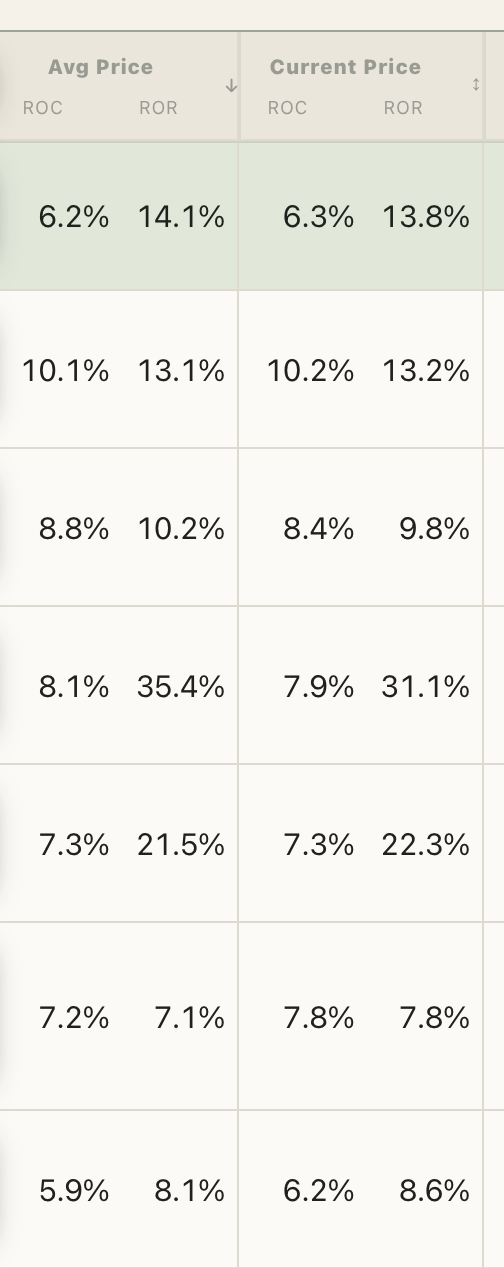
Each of the lines below that contain in the far left column the expected Return on Cash based on my average price in an individual stock we own.
You’d think it would be as simple as knowing your average, then cutting the things below that.
It’s not (sadly).
For example, the company up top earnings 10% on my cash is a pure-AI play.
Never before in company history has it grown so much, profited so much, and has such incredible luck.
And it may never again.
So using the 10% number is somewhat foolish, because although in the moment you’re earning 10%, it’s likely in the future that would decrease as revenue/growth/profitability decreases.
But then you must ask yourself, WHEN?
Which leads me to one of my favorite ever Buffett quotes:
“A bird in the hand is worth two in the bush…. well that’s mostly true in investing. But you also need to ask… #1, how sure are you there’s two in that bush? and #2, how long will it take to get them out?”
With a 10% annual yield, it implies we must earn these returns on our cash for 7 years before we earn our full investment back from cashflows.
Sometimes that might be paid out to us, but preferably the CEO keeps it each year, and can continue to re-invest at the same 10% rate or higher.
So far, this AI company has, but when does it stop?
Now shift attention to the bottom of the list, the 4.5% yielding company
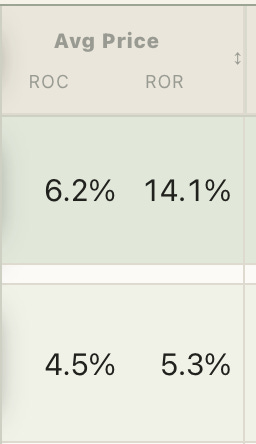
There’s a company who is stable, also growing key metrics 20%, however, it’s European, unproven to American investors, and is purposely lowering operating margins in order to invest in growth.
They grew their customer base to 12m+ in their recent report, a 20% increase from last year.
That’s very impressive.
But, the hit to profitability has investors scared.
Despite the CEO saying it’s not the right time to focus on pure profitability of those new customers.
He’s rather go from 10m to 12m customers at slightly worse margins, than go from 10 to 10.5 at great margins.
So when will he turn on the heavier monetization and less growth?
Imagine the 10% Company reverts to their normalized profitability rate, and the 4.5% Company stops re-investing and starts harvesting.
You might see the 10% become 4%, plus you suffer impaired principle because the stock would also decline.
And we might see the 4.5% increase to 8%, plus the stock would increase. Since it spent years re-investing, or dealing with a slow market, it’s fair to assume that 8% is the new normalized.
Does Buffet Actually Think Like this…?
Not identify, obviously. But directionally, yes, I think so.
I’ll explain simply.
Lennar is a top 3 homebuilder in the USA.
It’s stock was $75/share.
Almost nobody wanted it, you can see it was down 30% on the year.
But, Berkshire wanted it.
Berkshire bought Lennar’s stock so heavily it grew to be a 10%+ owner. (I bought it, too).
Lennar was trading at $75/share.
It’s reported tangible book value per share was $75.
In human language, the value of their real estate and land-rights equated to roughly to the entire value of the company.
That makes sense.
But then you realize they also EARN $4 per share.
So wait… Berkshire was buying a company at-cost of the real estate assets, and then getting the annual earnings for free?
Yes.
He’s buying the company for the same value of the real estate assets at cost, and getting the earnings for free.
But, it gets better.
That $4/75 is only a 5.333% return on book.
I thought Buffet wants 15% on his cash?
So then you strip back all the noise of ‘real estate will collapse’ from CNBC, and you look at the 10 year history of Lennar.
They average somewhere between $7-9 diluted normalized earnings per share.
Which 9/75 = 12%
Plus a 2.38% dividend, and there’s buffets 14-15%.
The key is that he’s willing to wait for it.
This brings me to another fave quote from Buff, he says,
“I’d rather have a bumpy 15% than a smooth 10%”
Lennar is a great example.
It feels awful buying it when rates are skyrocketing, everyone is selling, CNBC is telling you Real Estate is collapsing… and yet that is exactly when Buffet is buying.
All he see’s is 15%.
DISCLAIMER
I’m still in intense learning mode, so it’s fairly likely some of my assumptions are incorrect. DO NOT TAKE WHAT I SAY FOR GRANTED. Do you own research. You’re very likely to lose money, and even I’m afraid of my portfolio. It’s a dangerous game, very very very few people are Buffet. 99.999% of them fail miserly in stocks. So you’re better off just studying, waiting, and do not buy things without actually underwriting it yourself.
There’s also a major disclaimer that it’s BERKSHIRE buying Lennar, not Buffet directly. Or not that we know of. This makes it very hard to give full credibility to these lessons. And absolutely makes me second guess my decisions and assumptions. But, the normalized math does work for Lennar, and that’s what Buffet teaches. So if it’s him, or the spirit of Berkshire, it’s still better to learn from than ignore.
~Don
SUBSTACK.MEETDONSTEIN.COM
https://x.com/donversationz
P.s. Oh yeah! I was so busy explaining to you all the thinking, I forgot the real reason I wrote this today, because I’m going through some decisions around allocating between that 10% and 4.5%.
I almost think Buffet’s answer would be, ‘neither, too hard.’
I know Charlie Munger’s would be.
There’s a reason they love Coca Cola so much.
You’re basically never replacing their soft drinks in the mind of consumer, no company will ever compete with them on scale, and the business grows so slowly that the return on cash is the return on cash. What you see is what you get. The cyclicality, and investment phase, aren’t going to skew earnings power all that much. It’s just a quality company, durable, and growing. That’s what Buffet likes.
So would he buy this 10% yielding company I own? Probably not.
Would be buy the 5% yielding one? Probably not.
He would say something like, “they could make you money, absolutely. They could also loose you money. Depends heavily on the future, and I’m not smart enough to predict the future. So those are too smart for my circle of competence.”
And that’s why he’s the best.
And that’s why when I met him, I asked, what is the ONLY #1 THING that matters most for investing.
And he said….
“Learn your circle of competence. And wait for your pitch.”
So by me holding the quality company yielding 5% at trough earnings, or the quality company yielding 10% at peak earnings, in both scenarios I’m learning my circle of competence.
Buffet did this for 60 years.
He bought Berkshire at age 34.
I’m younger than that.
So everything I do is built around 60 years of learning.
60 years of getting better.
I’m not risking too much in either scenario, but I’m risking enough for it to make a difference.
They might both work out, they might both not.
But the more important lessons I’ll come from my observing them, and watching how I naturally act as a holder.
If I really can’t stand holding one type, then that’s great insight for our future investment strategies.
Charlie Munger said, “If you remove our top 20 investments over the last 60 years, we’ve really got a crummy track record. That means we made one good decision every 3 years.”
The key is to keep learning until that decision presents itself, then go in heavy.
~Don (again)
SUBSTACK.MEETDONSTEIN.COM (again)
https://x.com/donversationz (again)