[WEEK 22/52]: INVESTOR 1 vs INVESTOR 2: The Tale of Jekyll and Hyde
After analyzing this behavior, I’ve identified the core difference: one is willing to follow rules, and one is not. And I’ve also identified what that one rule is.
Before we review the first month, I want to explain the mental shift I’m going through.
Before this fund, I’d take 100% of my net worth and put it in Crypto. I’d mis-time the top and lose 75% of my profits, but I’d make 25% painfully. Stocks similarily did involve me going all in at risky moments.
That got us here. But it will not get me to where I want to go. If I’m going to grow into a professional money manger, the #1 rule is don’t lose money. And the best way to insure your profit is to work hard, say no a lot, orient towards value, and hold for the long term to let compounding work magic.
Those are fundamentally different strategies than my timing based trading mentality in which I am trying to shake.
Ok, now how does this all tie into the fund?
It’s been 1 month since we first funded our IBKR account. The very first penny our fund ever made was from Berkshire as a symbolic tribute to Buffet.
Plenty of first-time small issues have occurred this month; hitting wire limits from the bank, on-boarding to Admin back office, Claude Credit limits when coding our research software, etc.. But as is the nature of the beast.
As of this writing (May 15th, 1 PM ET), the fund investments are in total down -0.55% on Net Asset Value (-$8,000). We are down because the “trader” in me is still trying to emerge.
The majority of losses came from three FOMO-driven careless trades on DAVE(-$6,000K), QCOM(-$2,500K), CBRS(-$1,000K). We are intending to long-only invest, so my disappointment in this trading behavior is vast.
While I’m kicking myself for a lack of micro-discipline, I’m thankful for my macro-discipline. I limited risk exposure in the first month, I avoided too much chasing a hot market, and I kept 65%+ of the fund in cash. This naturally allowed me to make some mistakes (knowing I would), but nothing critical. However, if not corrected these will compound and run us out of business.
Our Top 5 performing investments as of writing are NVDA (+$1,500), AAPL (+$1,500), XOM (+$1,000), MSFT(+$1,000), ADBE (+$500).
Roughly $380,000 deployed so far of the $1,420,000 fund size.
My hope is to close more capital from my friend who committed in April to invest $250K when he receives liquidity in June. I think he’s open to raising it to $500K, but it’s quite clear I first need to prove I’m capable of being wise, thoughtful, and delivering performance. If I can’t do that, then I don’t deserve more money. I must prove myself.
My sole focus is on self-correcting the below mistakes, and organizing around a standardized deployment process.
As my adviser/LP wisely stated when we had lunch last week, “no LP pays for randomness.’’
So the below is an open-letter about the mindset shift I’m going through. Shedding my old skin as a trader/gambler, and emerging as a disciplined top 1% investor with a replicable process.
So I’m excited to show you all what I’ve built……
But first…
Hey, I’m Don! I LOVE INVESTING. If you do too, then stop, and subscribe below. If you hate investing, probably should also subscribe and I’ll teach you to love it. I set the goal to publish a thoughtful blog every Monday.. 52 of them! Don’ Daily is a recap of the entrepreneurship adventures I collect, as well as the new lessons I’m constantly learning about investing.
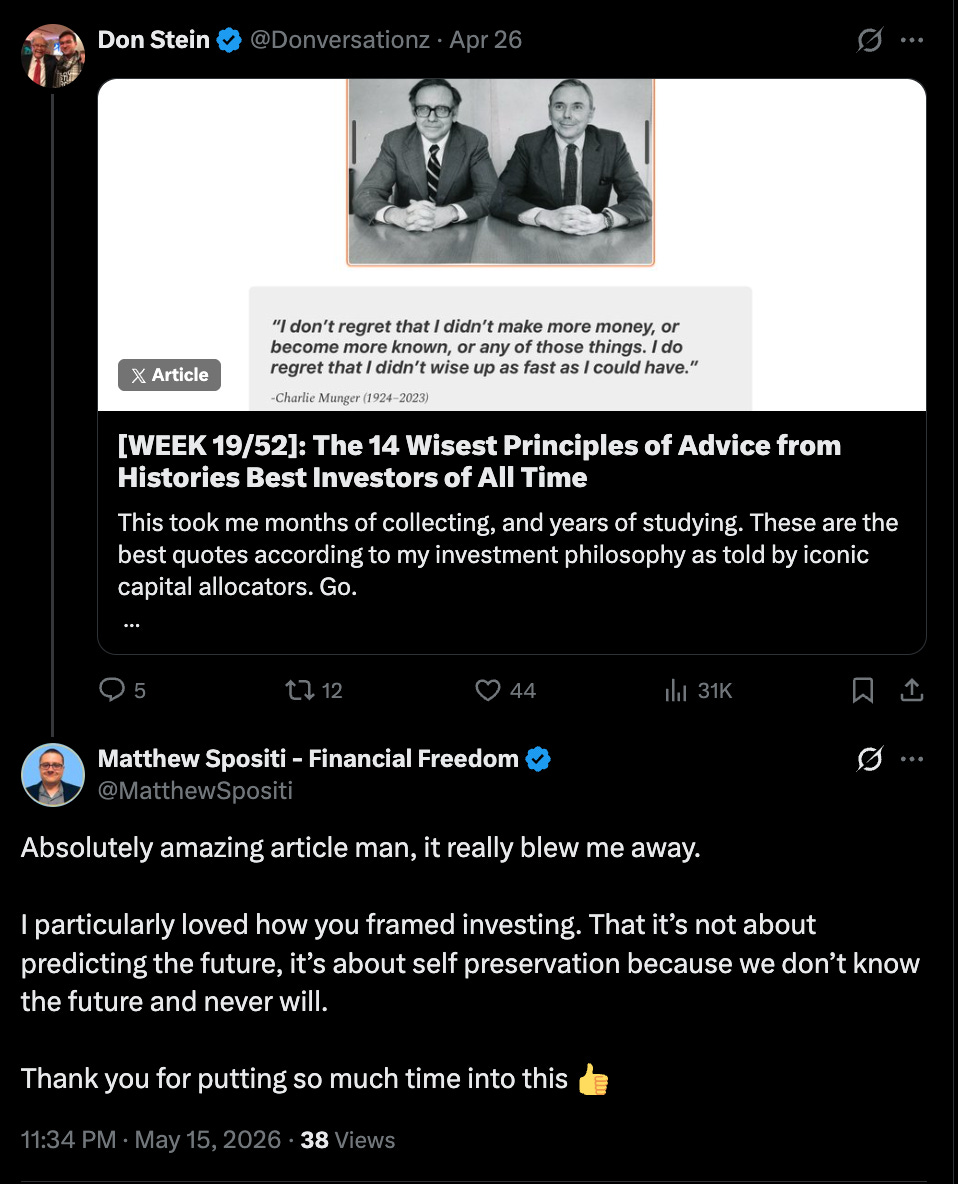
He’s a random guy from the internet who found my article (which is now up to 31K views!), and left a very thoughtful thank you.
I hope the advice works for you, and me, Matt!
Want to have your X or Linkedin tagged in our blog?
Engage on X and get your profile featured to our readers!
INVESTOR #1 vs INVESTOR #2
Jekyll and Hyde
I’d say the first month is a tale of two investors.
Investor #1 is insanely diligent, thoughtful, heavily research focused, disciplined, and errs on the side of caution when pricing in a margin of safety. He’s using our custom built website each time, and he is investing for the long term from a desktop computer.
Investor #2 is impulsive, undisciplined, youthfully hopeful, over-exuberant, passionate, risky, and unsettled. He’s triggered by CNBC and X, then moves fast on his mobile device to make a quick buy that ‘just must happen right now!’
After analyzing this behavior, I’ve identified the core difference: one is willing to follow rules, and one is not. And I’ve also identified what that one rule is.
Statistically, looking at the various units I’ve deployed over the past month; Investor #1 appears 50% of the time, and Investor #2 sabotages the other 50% of the time.
Investor #1 funded these deals:
NVDA: Bought 1 unit below $200 at FAIR price. Used low-risk stop-loss strategy to sneak in a second unit below $220.
APPLE: Bought 1 unit below $280 at FAIR price. Used low-risk stop-loss strategy to sneak in a second unit below $290.
SLDE: Did incredibly deep research on the shifting supply x demand dynamics in Florida’s insurance market. Found a company growing 20%, with a repeat IPO founder, large personal stake in the biz, history of success, trading at a price that so clearly was at or below FAIR it would be hard for me to make a mistake. Massive margin of safety. Stuck to rules, only bought 1 unit.
INDV: Did great research, am confident in my forward projections of their revenue and net income whereas even if they drop to a 16 PE next year, and only hit low end of income projections, we still walk away without losing money. Massive margin of safety right now.
ADBE: Also absolutely a FAIR price of $250, felt a GREAT price was $220. But it showed strength around $235 so bought a second unit on tight stop loss just before it bounced to $245. Then raise stop loss so we can’t lose money, but have upside.
CRM: This started with a mix of Investor #1 and 2, but Investor #1 took control over time. I’ll spare you the details, but Investor #1 did some smart disciplined things to get average price down without too much further capital exposure.
Investor #2 funded these deals:
Bought DAVE after it ran up 50% in a month, broke my 1 unit rule, got my ass handed to me (-$5K realized, $1.5K unrealized)
Bought CBRS after it run up 80% post earnings, at least stuck to my 1 unit rule, hardly even know what the company does, it blew past my “can’t lose more than $150 stop loss” and I had to realize a 7X loss (-$1K)
Bought QCOM after it ran up 50%, broke my 1 unit rule, kept trading in an out all week as it went from $240 to $200
Set my Meta price targets to buy 1 unit at a FAIR price of $615, became undisciplined and ended up buying 2 units at $260. Broke my rule (-$2K unrealized loss)
ADP saw the worst of both worlds. Investor #1 identified $199 as a very FAIR price, but didn’t buy it because he feared moving too early. Then ADP reported great earnings, shoots up to $218, which is where Investor #2 stepped in with massive FOMO and bought that local top.
ETH/BTC/BMNR/XXI/MSTR: Buying 4% of portfolio into crypto over the past two weeks in anticipation of the Clarity Act mark up seemed wise. We were up 5% after the Senate Banking commit made final approval. Didn’t take profits. Convinced myself this was a value buy, “XXI owns $3.5B worth of BTC at $80K, with an Enterprise Value of $3B there’s 12% delta.” But once again I broke my rule of 1 unit at Fair pricing, ended up putting in twice as much as I should have. And rode it down to take loss.
None of those operating businesses are inherently bad companies, in fact they’re all great, but the core difference stems from my deploying in a patient vs non-patient manner.
FOMO vs FOME
Fear Of Missing Out, vs, Fear Of Moving Early
Investor #1 operates from a place of, “It’s insanely unlikely that I will lose money on this over the long term, even in a worst case scenario, I won’t lose much..’
Investor #2 operates from a place of, “this is absolutely going to make money, and the window of opportunity is closing with each second I don’t make a move.”
Investor #1 is patient, waits for his pitch, and has fallen in love with the idea of hunting for bargains in high quality companies.
Investor #2 lets his emotions dictate action.
Now, not all of these mistakes happened when I had clear rules set, some happened prior. And, not all happened when I had the website up and running intended to prevent Investor #2 from taking over (which, although the website is not perfect, it is absolutely increasing the friction in which Investor #2 must overcome). But still, the behavior is unquestionable, and unacceptable.
Behavior Correction
Easier said than done
How come everyone knows to eat healthy and work out, yet not everyone does it? Discipline.
And that is exactly the challenge I’m facing with these rules, I know that I should stick to them without any veering, but sometimes that twinkie just looks so good. Or, sometimes I’m just too tired to go to the gym, so I’ll do it tomorrow.
Well, no. I don’t do that with my fitness. And I cannot afford to do that with my money.
3 simple rules I must follow
#1 Never Buy Initial Purchase Above FAIR Price, EVER. No Exceptions.
#2 One Unit only at FAIR price. Wait. Second until only after decline.
#3 No full underwrite and price ladder? You don’t buy.
I printed those 3 rules out on paper, and taped them all over my house.
Example of it Working
I bought PRIM on a Solar Energy thesis, well thought out, great biz, but I felt the FAIR price was $97. I bought it at $107 anyways. It went up to $115. Instead of being happy about this, I recognized I broke my rule, and sold it. It’s since dropped to $111, and I hope it goes to $97 so I can hold it in my portfolio. But, I knew it broke my Rule #1, and so therefore I had to sell.
My Theory on Why Investor #2 Takes Over
Investor #2 is not an idiot, he’s actually quite foresightful, but he’s just not disciplined.
He funded NXT and went up 10% in a day. But didn’t take profits.
He funded QCOM and went up 10% in a day. But didn’t take profits.
He funded ETH and went up 5% right after Clarity Act mark up, then didn’t take profits, and went above policy allocation rules.
He funded XOM and is up 6% on the position today.
Bought CRCL and rode it up 15% in a day.. Then rode it back down.
Buffet says: ‘If you have an IQ of 130, you can give 30 of it away. The most important thing for investing is temperament.”
My edge is Investor #2, but it’s a double edged sword.
Investor #2 is the engine, but if it overheats, the whole car breaks down. And we’ve been proven to overheat at a moment’s notice.
For me to grow into a top 1% investor, I need to maintain Investor #1’s rule-following discipline, combined with Investor #2’s insatiable curiosity.
In other words, I must let Investor #1 drive, and let Investor #2 control the music.
Wrap Up
Thank you for reading
As I said at the top, while I’m kicking myself for a lack of micro-discipline, I’m thankful for my macro-discipline. I limited my risk exposure in the first month, I avoided too much chasing a hot market, and I kept 65%+ of the fund in cash. This naturally allowed me to make some mistakes, but nothing critical.
I’m very proud of the hard work I’m doing on research. I feel very comfortable underwriting these companies.
And I’m extremely proud of the Diligence software I built with Claude.
The thoughtful nature I’m sifting through the market should absolutely lead to returns over time.
But the key for me is to avoid trading, optimize for buy+hold, and NEVER break my rule of buying a security above its FAIR value as determined by conservative estimations.
As Howard Marks said, “Investing is like amateur tennis. Don’t worry about hitting winners, just don’t hit losers.”
If you’ve invested with me, thank you. It means the world, and I’m doing everything I can to deliver the both of us outsized returns.
If you’re just a friend watching me grow, then thank you for caring, and I hope one day to manage your capital in a stress-free manner.
I put 100% of my liquid capital in this. So I must figure this out, and fast. I’m all in.
Show love on Linkedin or X! Get featured and tagged so your account can grow too.