

Hi Pioneers and Legends,
I’m writing this Thursday, but have a second date this weekend in Tampa, so hopefully by the time you’re reading this Monday that will have gone well :)
(Full article available here on X)
Today’s note covers three topics:
1: A poem by James McCrae
2: An update on our fund
3: Insights on Natural Gas and LNG
Email don@virtualrealityinvestment.com or DM me on X with interest to come pitch your stock idea on Friday. I’m working to schedule our second episode on Friday, ping me to join us!
‘Instructions Before Visiting Earth’ by James McCrae
I heard this poem the other day (featured at the end of the paragraph), and thought it was really quite cool. I wanted to share it with you all in case it resonates.
I believe in a central source of universal knowledge. See theories like Morphic Resonance by Rupert Sheldrake.
In short, he proposes that nature possesses a collective memory. This explains why turtles inherently know to walk towards the water when born.
And this theory applies to humans, it reframes our brains from being thinking machines into being antenna like receivers.
We receive signal from a central source (much like the Cloud and AI).
This poem below hits on that theme.
Instructions Before Visiting Earth
In the event that you wake up
and find your soul separated from source
and manifest into material form,
don’t panic.
Your condition is only temporary.
You have been selected for the
opportunity of human incarnation.
This 3D simulation is designed
to break up the monotony of eternity
by giving you a fully immersive
experience as a distinct ego identity.
Your body will serve
as your physical avatar as you
navigate a dense and dramatic reality.
There will be many distractions
causing you to forget your true nature
and origin. You will experience
a range of emotions, from joy
to loneliness to despair.
But remember – no matter
what trials and traumas you encounter,
your soul remains perfectly safe.
At times you may feel lost or afraid.
This is totally normal.
If you ever need guidance,
simply slow down your busy mind
and bring your awareness
to the quiet place
inside yourself.
On this planet, nothing is permanent.
People and things will come and go.
You will fall in love and form sentimental attachments
only to lose everything you hold dear.
So cling to nothing too tightly, even yourself,
and when it’s time to let go, let go with grace,
for nothing is owned, only borrowed.
As you walk among
the people on the planet,
try to be a good guest.
Tread lightly. Remember
that you are only visiting.
Don’t make a mess.
Listen more than you speak.
Give more than you take.
Don’t keep your soft heart
locked inside a glass cage,
protected from wear and tear.
You’ll never make it out alive
and time passes quickly.
So come back with some battle scars
and good stories to tell.
For all my XR fans out there.. you’ll immediately pick up on some of the jargon.
“3D simulation” and ‘fully immersive.’
I thought it was a cool poem, hope you enjoyed.
Fund Update + Investing Lessons
I took the gloves off.
Realized I was being overly technical and rule-oriented. That’s not my natural state.
I’m in the ring now, but before I get into the strategy, let’s rewind the past few months.
I tried 3 distinct investment styles over the past 12 months, each was a VERY healthy exercise to do.
3 Investment Style Experiments
They were as follows: value-oriented vs policy-oriented vs narrative-driven
1: Can I do a pure play value-oriented buy-and-hold Warren Buffet style?
2: Can I do a disciplined policy-oriented deployment David Swensen style?
3: Can I do a narrative-driven trading practice Stanley Druckenmiller style?
I’ve been really truly putting in the hours of studying all the various styles, and trying them out.
I’ve meticulously built strategies, ripped them down only when I felt it wasn’t for me.
There were three pivotal moments, in chronological order.
1: “ADBE is a value play.”
It’s not.
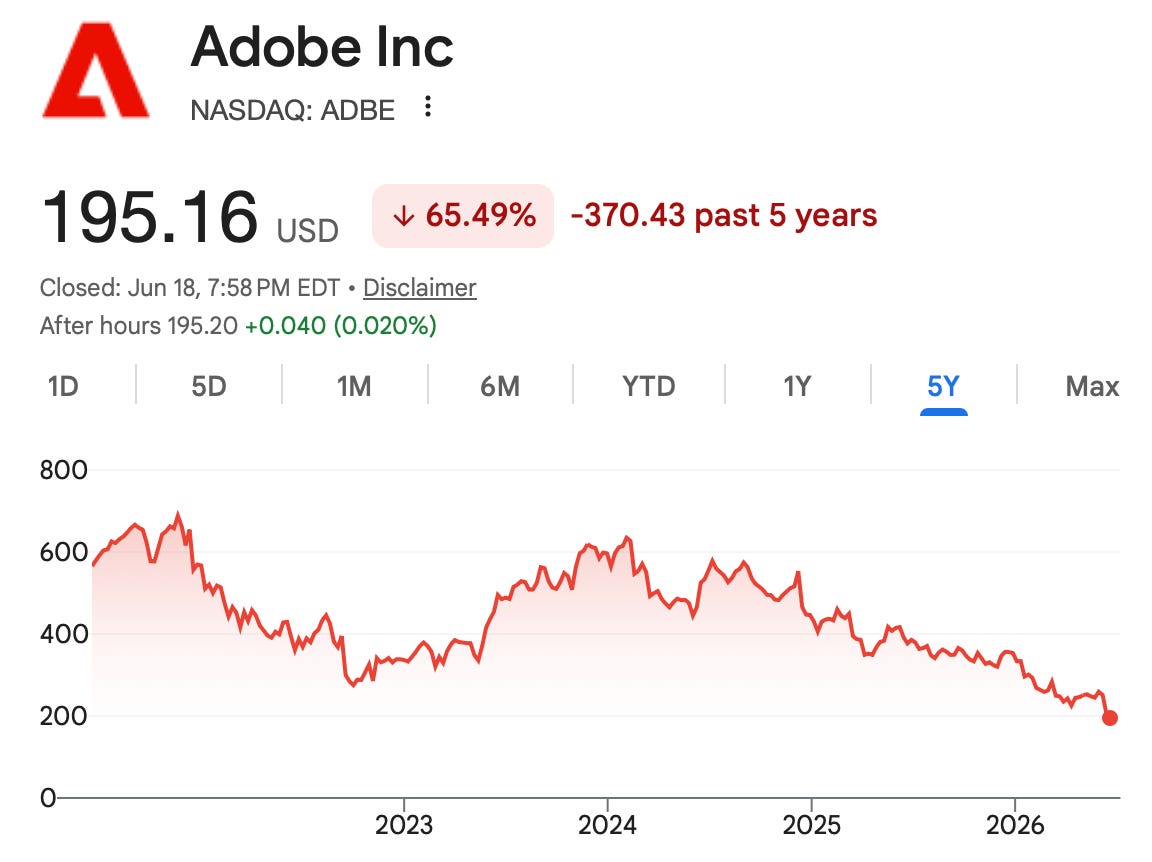
This is ADBE’s 5 year chart, and it’s still going down.
I looked at the numbers and thought they were superb. Everything a ‘value’ investor looks for.
Strong ROIC, low capital intensity, 10%+ owners earning yield, minimal debt, proven track record over decades.
So many good things.
And then when they reported their numbers this week, which are very strong, it dropped like a rock.
Investors hated it. But I’m a value investor, I thought ‘the market’ should not matter?
Well.. let’s be honest with ourselves, I’m probably an average value investor at best.
I love the principles of value investing, but sitting through a 65% decline for years, while the market rips…. something is off. Obviously, I am not understanding something fundamental.
And this is what I wasn’t understanding: value is subjective.
A company doing $100M profits, growing 50% annually, but trading at a P/E of 100, should still be considered more of a value play than a company doing $5B profits, growing 12%, and trading at a P/E of 10. Wait a minute… that doesn’t make sense!
That is literally comparing a trendy stock I’m watching to Adobe. By all means, the latter is a much stronger company, and on the surface clearly the better investment.
So then… why didn’t it work?
Because beauty is in the eye of the beholder. Value is subjective.
SpaceX is trading at $1.5 Trillion… and losing money hand over fist.
But Elon has fans, and the lure of Space travel triggers imagination.
And capturing imagination seems to hold as much, if not more value, than just today’s numbers.
We can get more into all this, as I have millions of thoughts, but I’ll sum it up by referencing the Efficient Market Theory.
Efficient Market Theory
This basically says that any information available today, is already priced into the stock.
Therefore, you find value by having an insight of the future which differs from the mainstream.
And since stocks are mostly 100% efficient, your returns over time are directly correlated to the delta between your view of the world and the market’s. Finding niche’s enables you to widen that gap.
Speaking of gap…. I also want to note something VERY interesting.
As I’ve been questioning the ‘value investing’ concept, I thought it smart to study the history of accounting.
Primarily asking myself, was it easier for Buffett to find obviously value in the 1960’s than it is today?
GAAP History
The Depression happened, and coming out of it every company had different accounting practices.
What a nightmare.
So the SEC was formed in the 1930’s, and by the 1960’s they had almost finalized rules around Depreciation.
Think about that….. one of the most important fundamental concepts in our accounting system, wasn’t even fully fleshed out until half-way through the 1900’s.
So when Buffet comes onto the scene around that time, his ability to study new concepts creates a massive advantage.
And Benjamin Graham in the 1930’s was able to find value.. because literally there were companies trading below their liquidation prices.
But in a world of AI, internet, X, and speedy information…. not to mention algorithm trading… there is NO way that those same advantages exist today.
And so… you really have to think about… WHAT IS THE MODERN EDGE?
Bringing this all back to Adobe
The stock is missing what I might be now starting to consider the most important aspect of investing in public equities.. Adobe was missing a durable growth narrative.
I will skip over the obvious issues like it’s CEO and CFO have stepped down…
The market can look past that under the assumption they pick a great leader.
But the “durable growth narrative” relied entirely on ADBE accelerating it’s growth.
So when they reported that Net New ARR decelerated for the first time in 10 years….
That breaks all hope for the narrative.
So I’m not necessarily saying Adobe is a bad bet, it’s certainly a more reasonable price than ever before, but that is in comparison to the durable growth we came to expect. If there’s already starting to be chinks in the armor… then investors are pretty smart, and it’s likely this company grows, but never again achieves its 25% YOY growth across all vectors.
The only hope for the rebirth of that narrative is their AI product becoming indispensable, and unable to be copied. Which is a tough sell in a world of vibe coding and pools of AI devs all across the world.
The lesson I took from that = GREAT MODERN INVESTMENTS ARE A MIX OF NARRATIVE X GROWTH NUMBERS.
2: Buffet + Munger Clip
I’ll keep it short. But I heard a clip from the 1990’s where they shared their investment process of identifying value.
Munger said, “we got subpoenas for our staff notes.. but not only do we not have notes, we don’t have staff.”
And the crowd laughed.
But really think about that…..
They just sit there all day talking, reading, studying. They’re not running complicated DCF Excel equations, and they’re not pretending they can be so precise.
As Buffet later says, “I’d rather be generally right than precisely wrong.”
He is looking for things that are so obvious that he doesn’t need a note pad, and he doesn’t need to run precise numbers, because it’s so obviously a good deal.
The discipline to wait for that is what makes Berkshire an iconic brand.
Buffet goes on to explain that he just does basic back of napkin math in his head, and thinks.
The lesson I took from that = GREAT INVESTORS USE COMMON SENSE AS THEIR PRIMARY TOOL FOR DEPLOYMENT.
3: Howard Marks book
I’ve been reading voraciously this year. And so I thought it would be helpful to myself (and maybe you) if I read a chapter from my fave books.
This helps embed the ideas deeper into my subconscious.
My friend Corey said he was cracking up when watching it. I re-watched… and yes it’s a bit more of a comedy show than just a chapter reading.
And when I read the first chapter of Howard Mark’s book, it became quote clear by the end of page 2 (1:30 - 3:41 in the video) that he specifically calls out, and emphasizes, the idea that investing should be intuitive, not formulaic.
Key Topics Covered:
Introduction to the book (0:00 - 1:29): Introducing Howard Marks and discusses quotes from Benjamin Graham, Albert Einstein, and Charlie Munger regarding the difficulty of investing.
Investing as an Art (1:30 - 3:41): Discussion on why investing cannot be fully routinized or reduced to simple algorithms because markets are psychological and unpredictable.
The Goal of Beating the Market (3:42 - 5:35): The creator emphasizes that to achieve above-average results, one needs superior insight rather than just luck.
Second-Level Thinking (5:36 - 8:02): The core concept of the chapter. First-level thinking is simplistic and superficial; second-level thinking is deep, complex, and considers the range of future outcomes, consensus psychology, and how to position oneself differently.
Examples and Framework (8:03 - 13:58): The creator applies these concepts to a stock (UAMY), discusses the importance of having non-consensus views, and explains a matrix for understanding conventional vs. unconventional behavior in the market.
Conclusion of Chapter One (13:59 - 15:35): The creator wraps up the discussion on why first-level thinkers are common, which in turn creates opportunities for second-level thinkers to succeed.
That was the final puzzle piece I needed to hear.
I had been studying and studying and studying and studying for years, I’ve tried so many different styles where I ‘stick to those rules.’
But now I need to let loose.
It’s VERY similar to an athlete who practices all week, but then on Football Sunday they are trained to stop thinking about the technicals, stop thinking about the mechanics, and just go play.
Let nature and flow-state control you.
So that’s what I started doing on Weds.
And also built you all a really incredibly well done, and complex graphic showing the parallels of investing to football. :)
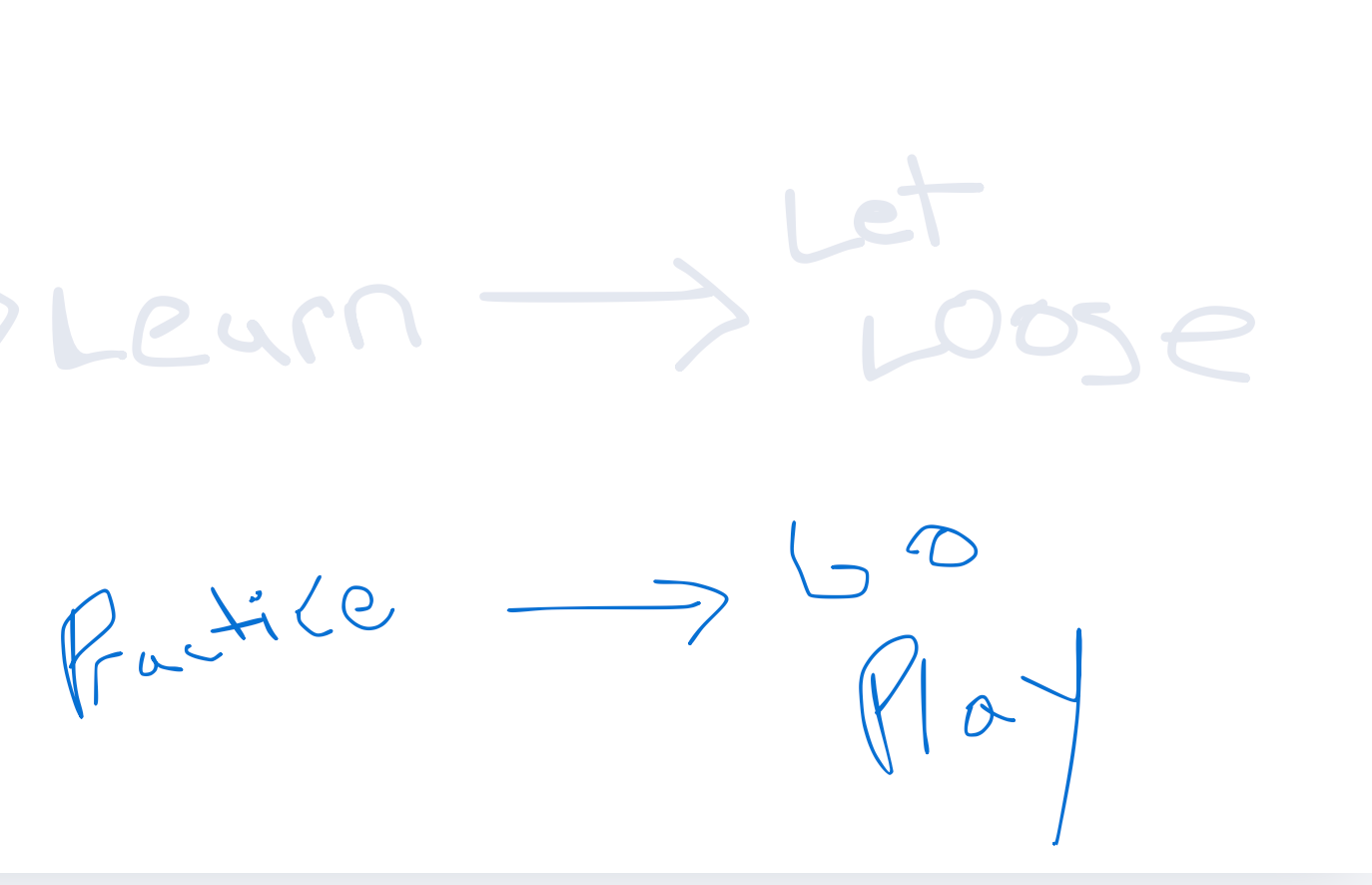
So that’s what we’re doing… letting loose. NO rules.
And ONE goal - make money.
Rather than making my goal to follow the rules.. the only concern should be if this trade/investment/thesis will make money.
I’ve been living by that, and things are starting to feel way more natural.
It is not yet showing in the numbers (although we made more money in 3 days than 2 months), but it is showing in my own flow state.
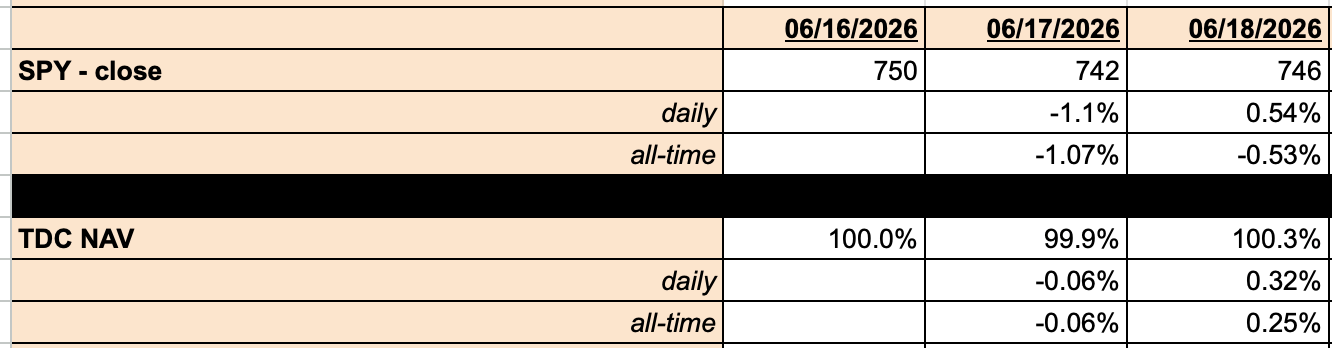
So let’s hope we can compound this, and continue building our own unique investment style crafted around who I am by nature.
3: Insights on Natural Gas and LNG
This is a long newsletter today. If you made it all the way, good for you!
I just opened the camera and started working-remote live.
It’s basically just me talking through my Natural Gas thesis, and researching LNG 0.00%↑ (Cheniere Group).
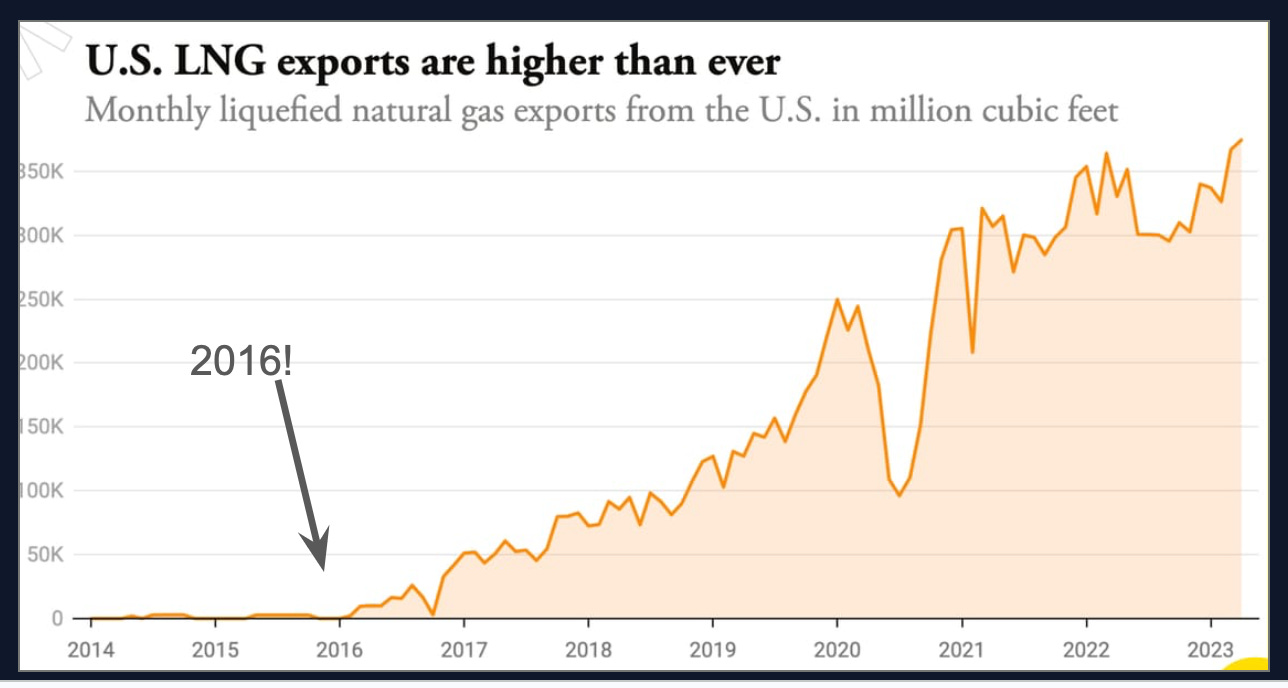
Chenier are the largest LNG exporters in the USA, they bought the prior leader in 2015/2016 when they went out of business.
And you can see by this chart…. that was pretty great timing to get into the LNG export business!
I’ll save my breath since I assume almost none of you made it this far, but watch the video if you want to hear my raw thoughts.
p.s. Email me if you want to Pitch your STARTUP or STOCK Idea at our Friday Convo.
This is a GREAT opportunity to get feedback on your investment pitch from me.
I saw the All In Podcast hosted and episode where four fund managers pitch their Stock ideas like a startup.
I love that.
Like Shark Tank, but you talk your book.
Join us on our Friday livestream where you can pitch your stock pick as if you're on Shark Tank. We'll ask you a handful of questions after your pitch, and hopefully we can all see the value you've discovered! We'll also of course feature links to your social profiles to help you gain followers who appreciate your perspective. Apply here:
I’m looking for the next 2 people who want to pitch their stock on Friday.
Please email me directly if interested: don@virtualrealityinvestment.com


Good day Don!
Noticed your X account got suspended, sorry about that..