

This article was originally published on my X blog last week, but has been re-worked and improved for our Substack readers.
Today’s Article is inspired by this quote:
“Extreme patience combined with extreme decisiveness. You may call that our investment process. Yes, it’s that simple.” -Charlie Munger
Eye-of-the-Tiger Investment Philosophy
What is the definition of my Eye-of-the-Tiger investment philosophy?
Simple. A tiger waits, and waits, until the moment is right, then it leaps.
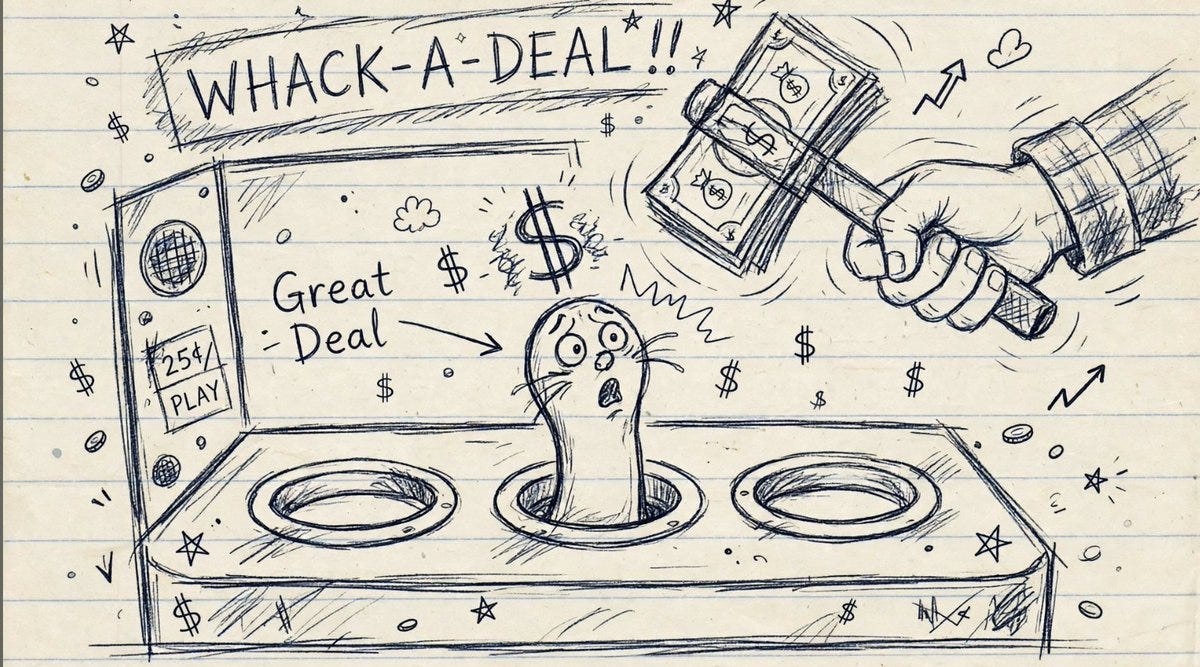
As Warren Buffett says, “most people confuse action with progress,” highlighting that the real skill of a top investor is being patient when there is nothing to do, and acting swiftly when opportunities poke their heads out like whack-a-deal.
Tigers are solitary stalk-and-ambush hunters. They camouflage, silently close in within 25 meters of prey, and then when the moment is right ***POUNCE!!!**
They overpower victims with their sheer patient strategy.
The tiger might catch one meal per week, the other days consuming, protecting the carcas, and then resting/preparing for the next hunt.
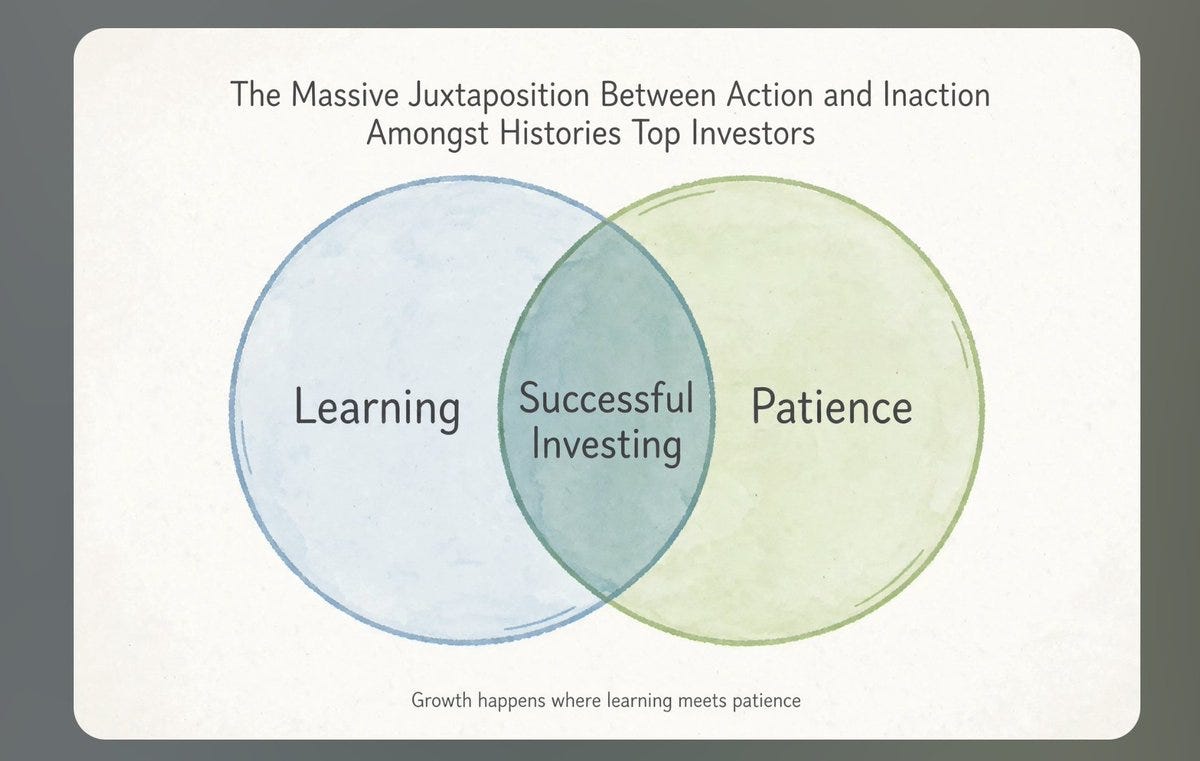
The more I study stocks the more I reframe investing as just the overlap between learning and patience. Just as luck is opportunity meeting preparation. Or just as life is the discipline of using nurture to better nature. The real investment skill is being able to flip between inaction and action when your patience finally pays off.
As Charlie Munger says, “Buffett is really, really good at doing nothing when there’s nothing to do.”
He is not literally doing nothing. He is away learning. But financially he is being disciplined. So it is nothing for the sake of waiting for the right moment, rather than nothing for the sake of laziness.
I love investing because it is so analogous to thinking. The never-ending question of what is the right way to invest and what to invest into matches the bigger question of what is the right way to live and what to do with my time. We invest money into stocks and time into our lives. Both lead to some percentage of those investments being a massive regret. That is unavoidable. Not everyone you give your time to will provide you a return on time, and not every deal you finance will provide you a return on investment.
Separate the concept of “deal” from the result
The real investment skill is being able to flip between inaction and action when the moment occurs. That trigger can only be flipped through intense, genuine, deep learning. Enough learning that you can common-sensically explain the key factors that make this deal a great result or a failed result. And that is the other key point. Separate the concept of “deal” from the result. A great deal can have a poor result, and a bad deal can have a wonderful result. Luck and chance decide those. Even a deal with a 99 percent chance of success can go south once a century.
So the real wrapper of learning and patience is discipline. Discipline waits for something specific. Fear waits indefinitely. Discipline waits because it knows better. Fear moves because it thinks it is missing something.
The watchlist process and the entry price
Great investors win in two areas: the watchlist process and the entry price. All other aspects of the job are tomfoolery. If you have 50 well-studied quality companies on a watchlist through learning, sooner or later they are going to drop low enough to be purchased at a great price through patience. Patience without learning ironically creates impulsive actions because you are basing decisions on real-time information rather than unique insight. Learning without patience gets you a portfolio of 40+ over-excited names with only 55% conviction in each one. Just enough to hold them, but not enough to give you a true edge.
Here is how Morgan Housel put it in The Psychology of Money:
“Investing is not a hard science. It is a massive group of people making imperfect decisions with limited information about things that will have a massive impact on their wellbeing, which can make even smart people nervous, greedy and paranoid. Richard Feynman, the great physicist, once said, ‘Imagine how much harder physics would be if electrons had feelings.’ Well, investors have feelings. Quite a few of them. That is why it is hard to predict what they will do next based solely on what they did in the past. The cornerstone of economics is that things change over time, because the invisible hand hates anything staying too good or too bad indefinitely. Investor Bill Bonner once described how Mr. Market works: ‘He is got a Capitalism at Work T-shirt on and a sledgehammer in his hand.’ Few things stay the same for very long, which means we cannot treat historians as prophets. The most important driver of anything tied to money is the stories people tell themselves and the preferences they have for goods and services. Those things do not tend to sit still. They change with culture and generation. They are always changing and always will.”
That is the heart of it. What price makes this a clear buy? What evidence would prove my thesis wrong? And what am I waiting for, exactly?
When you act without full confidence, you retreat
I am mostly in cash right now. Here is why. Here is my discipline. Here is what would change it. If patience is truly my edge, it should survive through any condition.
Here is my process: search, look, learn, study, and know companies through and through. Here is why I am patient. Because when you act without full confidence then you retreat right at the moment when you should be leaning in more. You should be prepared for that lean-in moment and ensure you are getting a great price to begin with. Here is what triggers action: when the actual price we set gets hit. This should be low and a GREAT price.
Practical framework that keeps me honest
The practical framework that keeps me honest looks like this. Only buy when it is a true no-brainer. Before pulling the trigger I run through these questions:
Great Price?
If it dropped tomorrow to my true no-brainer price, would I be pissed I bought today? Stop if yes. Then this is not the price yet. Wait for it.
If it ran up significantly from here without me, would I be pissed I did not buy? Stop if yes. No real conviction. You do not want the company. You want the chart.
Am I buying because this is truly a great deal at a great price or because I think it will go up? Stop if it is just “it will go up.” That is a bet, not a price.
Investment Style Fit?
Did I wake up planning to actively trade or monitor positions today? Stop if yes. You did not plan this. You never want to trade. It is a reaction.
What am I trying to achieve or protect by watching the market this morning? Stop if protecting losses. That means you did not buy at a great price.
If I had bought at a true no-brainer price, would I still feel the need to actively monitor? Stop if yes. A great price doesn’t have you worrying. You’re proud of the discipline.
Key Question
And before any of the above: Have I already done the deep work to know exactly what my true no-brainer price is for this company? Stop if no. Do not buy anything yet. Keep studying.
That is the discipline. That is the great price plus never sell framework that turns the juxtaposition of action and inaction into peace and compounding.
Maybe it is everyone. Maybe it is just me. I have a plan but get pivoted by market conditions I do not control. And then never see the plans fully through. Now that is not a bad thing as some plans would not have seemed to have worked in retrospect. But still there is a pattern. I get an idea off the ground, then cannot monetize it properly. Spatial Collective was my first time properly profitable company out of three. This fund MUST make money.
Clarity of gaze = Win without needing to chase momentum
In order to harden my investor gauge I have been studying like mad and writing privately and publicly. Deep dives because they sharpen my edge. Going deep into Meta, Dave, LNG and others helps a ton with confidence in knowing what I own.
I have a guilt fear of LPs not thinking I work hard because we are not making money yet. But the truth is the market does not care if you look busy. It only cares whether, when the great price finally appears, you have the clarity and courage to act. And I am working so hard. It is just the reward is delayed from effort, and I’ve made plenty of mistakes that have slowed compounding. Dumb mistakes. -_-
To solve it I’ve taken every action I can think of. The one that has worked best so far is opening a second brokerage portfolio, and transferring positions from my ‘buying’ portfolio to a separate ‘hold’ portfolio. The psychology difference of going through the effort to transfer the stock each time makes the bar that much higher to sell it. Hopefully, I don’t sell it. That’s the point. Trust my read, be patient, wait for the business cycle to execute fully.
Being fearful of a great price, because you’re buying it when most others aren’t not... that juxtaposition is not the enemy. It is the entire game. Learning sharpens the eye. Patience protects the calm. Discipline flips the switch at exactly the right moment. And that is how you win without needing to chase momentum.
~Don
The real investment skill is being able to flip between inaction and action.
