

Pretty much every stock I write about goes straight down right afterwards. So do not take this as investment advice, take it as myself trying to learn how to analyze companies.
Meta Platforms, Inc.
👉 This article was originally written July 8th at 3 PM on X.
I feel I have an edge on Meta considering I worked there during the peak of the Metaverse debacle. I should be able to analyze their Datacenter spend better than average, so, here we go…
52-wk Range: $520 – $796
Article Highlights:
1: “DeepSeek can copy model architecture. But... Nobody can copy 20 years of privately collected social-behavior and advertiser-performance datapoints.”
2: “In 2025, ad impressions rose ~12% while price-per-ad rose ~9%. Volume and price up together... the classic pricing-power signal.”
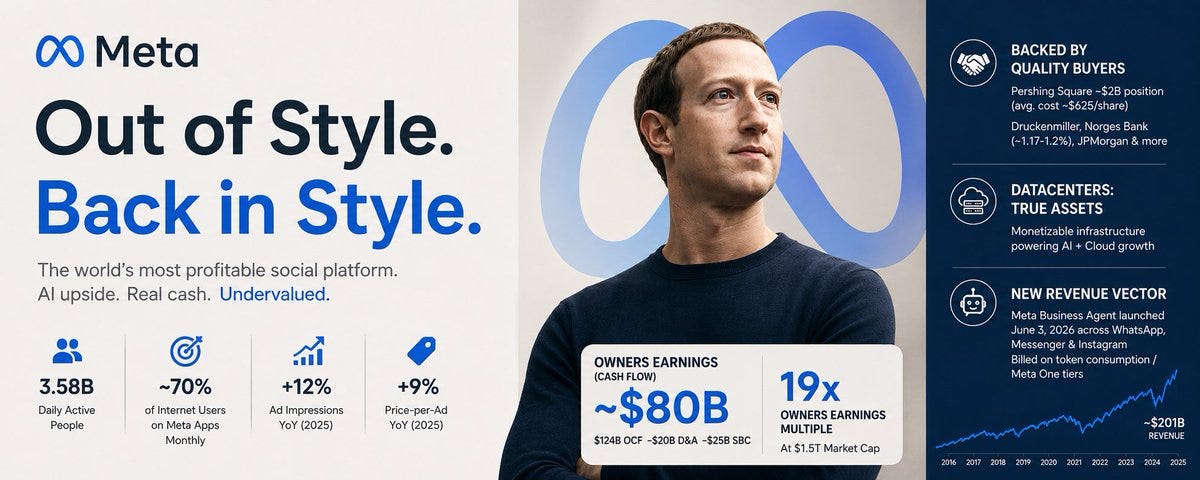
3: “Pershing Square built a ~$2B position (roughly 9-10% of the fund, their biggest tech bet) starting around Nov 2025 at an avg cost near $625/share. In their Feb 2026 investor presentation, they explicitly called it a “deeply discounted valuation for one of the world’s greatest businesses” due to AI upside not being fully appreciated. Druckenmiller, Norges Bank, and JPMorgan all added too I believe. Norges Bank (Norway’s sovereign wealth fund) are a long-term holder with a sizable stake (~1.17-1.2% of Meta).”
Every 90 days on Earnings, we all remember, “Oh! Meta is like the best most profitable business of all time.” And then the other 89 days we seem to watch those profits get thrown into a burning fire pit of money. The Oculus pit. The Over-hire pit. The Metaverse pit. The Datacenter pit is the next investor dilemma.
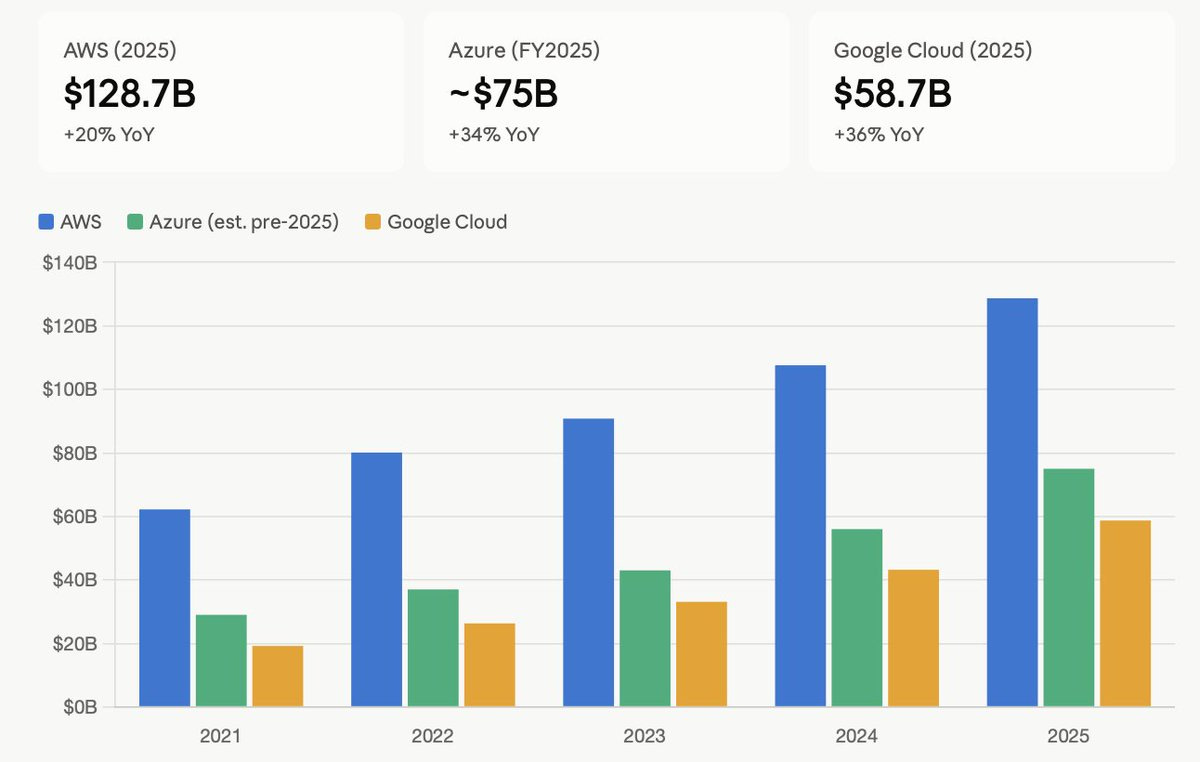
But IMHO, Datacenters are true monetize’able assets. A VR brick attached to your face is a research project. So given the proven datacenter market, and clear 30%+ Growth for Google/MSFT/AWS Clouds.... I think there’s a much higher floor for Meta’s datacenter spend than most give credit for.
We own this one, and our thesis is simple: this is a wonderful business that periodically goes out of style and then comes roaring back, run by a connected, technical founder who keeps making the right long-term bets (as ugly as it may look, sometimes).
Owners Earnings, Warren Buffett Method Cashflow Stats:
$124B operating cash flow
-$20b in D&A, -$25b in SBC... get us an Owners Earnings Cashflow of ~$80B
At $1.5T market cap that’s 19x multiple
Vs. Historical norms: Pretty much anything under 20x feels more than fair.
Being fair — the risk arises from the next 3 years of FCF going to 0. But, given how depreciation accounting works vs cash capex, the Owners Earnings would still remain fairly strong. The argument agains the Free Cash Flow method is… DUH, everyone can see that. And stocks don’t move on obvious. So my initial buy thesis at $605 was based on giving more faith to the FWD Owners Earnings than the rest of the market.

Key Highlights
The out-of-style / back-in-style pattern is the whole thesis. Meta grew from ~$27.6B revenue (2016) to ~$201B (2025) — a near-8x run with only one down year (2022, -1%). Each time the market declares it dead (privacy in 2021–22, metaverse waste, now AI capex), the core ad machine keeps compounding and the stock re-rates back up. This company has a LOT of leeway..... We’re currently in one of those “out of style” windows.
A connected, technical founder still at the controls. Mark Zuckerberg founded the company, controls the vote, and has a 20-year record of big bets that looked reckless and then paid off (mobile, Stories, Reels, open-source Llama). Because of Zucks’ age, there’s a chance he could be at the helm for another 30 years as CEO. That would be something special, and vastly supporting the thesis for compounding IMHO. He’s also gotten politically connected this year, bringing on Dina Powell McCormick (ex-Goldman partner, ex-Bush/Trump White House) as President & Vice Chairman.
Most likely the strongest personal data moat in tech. 3.58 billion daily active people, DMing, liking, etc... ~70% of all active internet users touch a Meta app monthly. The network effect, 20+ years of behavioral data, and advertiser lock-in (years of pixel/audience data, Advantage+ campaigns that improve the longer they run) are essentially impossible to replicate. DeepSeek can copy a OpenAI model architecture. Nobody can copy 20 years of private social-behavioral and advertiser performance data.
Elite economics, real cash. 82% gross margin, ~41% operating margin, ~30% net margin, and operating cash flow that compounded from ~$50B (2022) to ~$116B (2025) — a ~32% three-year CAGR. For every $1 of net income, Meta generates ~$1.92 of operating cash flow. The earnings are backed by cash, not accounting.
AI is quietly already paying off in the core. Advantage+ automates targeting, bidding, and creative and already handles
in annual ad spend. In 2025, ad impressions rose ~12% while price-per-ad rose ~9% — volume and price up together, the classic pricing-power signal. The open-source Llama ecosystem (1.2B downloads) is crowdsourced R&D that flows straight back into the ad-targeting stack.
Diversifying Revenue Streams. On June 3, 2026 Meta launched Meta Business Agent — the first time it has charged for an AI product — across WhatsApp, Messenger, and Instagram, billed on token consumption / Meta One tiers. This is the “second revenue vector” the bull case needed, attached to a platform of billions of users from a standing start.
Moving away from pure ads, it would be nice to see them mix services from companies via WhatsApp, or Cloud revenue. Personally, I vote they go heavy into Cloud.
Bought at a similar ~20x by quality buyers.
Pershing Square built a ~$2B position (roughly 9-10% of the fund, their biggest tech bet) starting around Nov 2025 at an avg cost near $625/share. In their Feb 2026 investor presentation, they explicitly called it a “deeply discounted valuation for one of the world’s greatest businesses” due to AI upside not being fully appreciated.
Druckenmiller, Norges Bank, and JPMorgan all added too I believe. Norges Bank (Norway’s sovereign wealth fund) are a long-term holder with a sizable stake (~1.17-1.2% of Meta).
Turning Negative to Positive?
Google was being attempted to be broken up when OpenAI launched GPT. And what was the largest threat and worst-case to Google’s business... ended up saving them in court, and gave them new life as a growth stock.
Meta, I foresee, will turn their extreme negative to an extreme positive. They’ll do so by growing a new revenue stream as a Cloud provider. Meta Cloud.
The “Negative”
The capex is staggering and the FCF dip is real. 2026 capex is guided to $125–$145B (up from $72B in 2025), and a ~$30B+ depreciation wave is about to hit the income statement before those AI investments have generated returns.
The positive twist:
It took AWS (first mover) 8-10 years to hit $10B
MSFT took 6-8 years to hit $10B revenue.
Google took 4-6 years to hit $10B revenue.
Can Meta do it in..... 2-4 years!?!?!?!?
If the pattern of new entrants eclipsing $10B of revenue continues, it would suggest they could absolutely hit that within 4 years. Which would be wild, but not surprising as long as they start selling... like, yesterday.
Note, all 3 clouds are still growing 20-40%... there’s plenty of Demand for Meta to step in. If they just execute...
Key Risks
AI capex with no (direct) ROI — the central bear case.
2026 capex jumps to $125–$145B, nearly doubling, and Reality Labs still burns ~$4–$6B/quarter. A ~$107B step-up in contractual commitments hit in a single quarter. If Family of Apps growth decelerates while losses and depreciation balloon, the “profitable core funds the future” narrative breaks — and the stock gets punished regardless of headline revenue. This is why the stock is off its highs.
Litigation — escalating, not resolving.
In March 2026 a California jury found Meta and Google liable in a social-media-harm case (Meta on the hook for 70%). The first federal MDL bellwether trials begin June 15, 2026, and Meta’s own 10-K warns these suits could “significantly impact” results, with potential “material loss.” Thousands of consolidated cases hang on these outcomes.
Regulatory overhang — reduced, but alive.
The big one eased: in November 2025 a judge ruled Meta is not a monopoly, blocking an Instagram/WhatsApp breakup — but the FTC appealed in January 2026, so it’s now at the D.C. Circuit. In the EU, Meta took a €200M fine and a compliance deal rather than a total behavioral-ad ban. Worst cases are off the table; scrutiny is not. I’d also argue there are other potential risks amongst Global and Local govt’s.
Ad-revenue concentration + macro.
~97% of revenue is advertising. The revenue floor is unusually strong (10M+ SMB advertisers with no real alternative at their budget), but a tariff-driven recession squeezes SMB ad budgets first, and the Chinese e-commerce category (Temu/Shein, among the fastest-growing spenders) is a concentration risk if US-China trade tightens.
The AI frontier could slip away.
Meta AI and Meta’s pivot to a closed model (Muse Spark) is unproven. If Meta’s strategy turns out to be a consumer dud, we’ll fully need to rely on Ad rev + Cloud rev to justify the datacenter spend.
It now appears wise of them to roll their own model, as giving 20 years of data to Claude seems imprudent by Meta.
Btw, Meta dropped a new IMAGE gen model yesterday.. kinda dope!
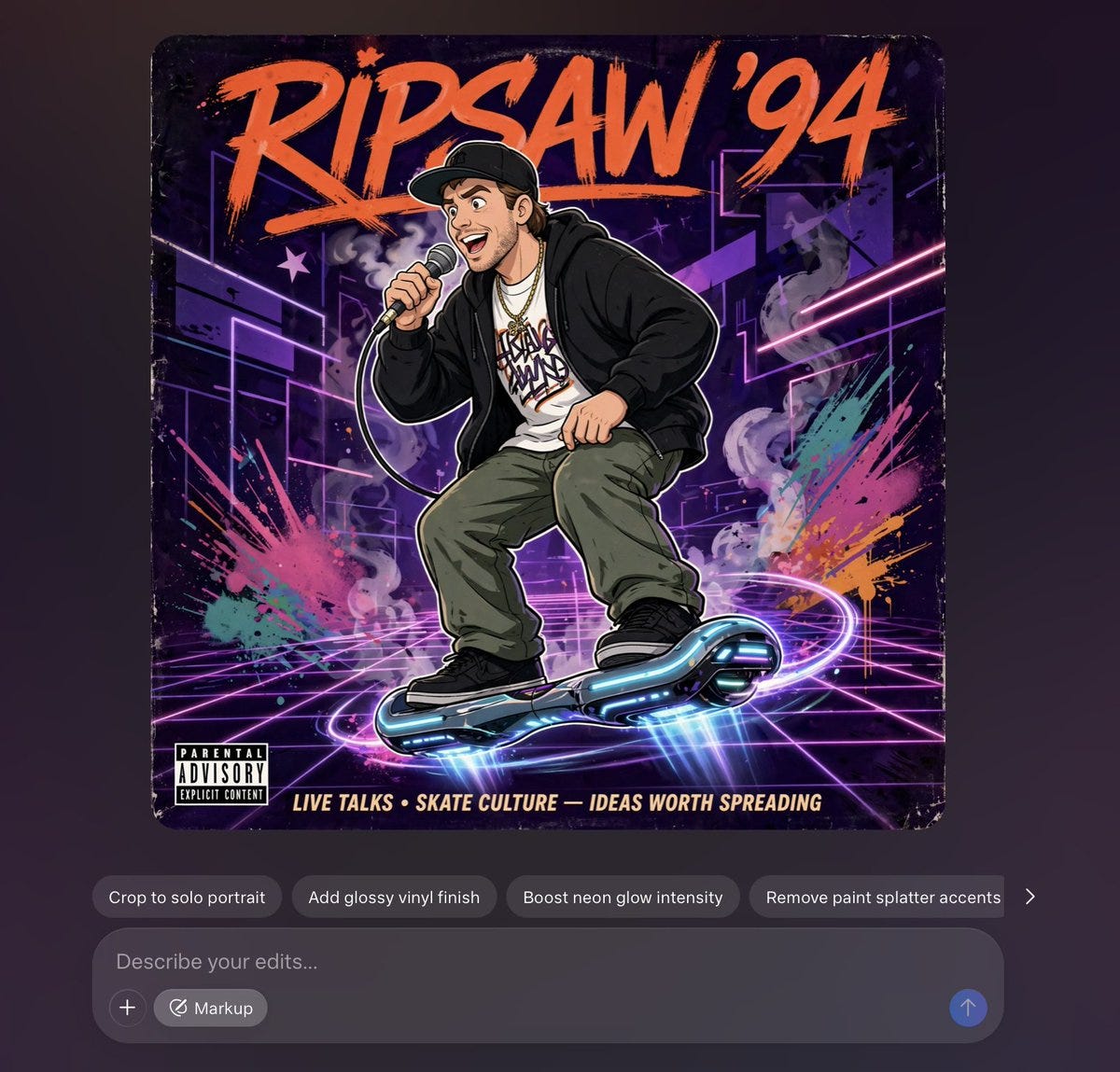
Random image gen from new META AI chatbot.
Founder key-man / governance.
Zuckerberg controls the vote, a strength (long-horizon bets) and a risk (no shareholder check if he spends without ROI again, as in the metaverse era). The whole thesis leans on his judgment continuing to be correct. Thankfully, he has a lot of wiggle room given strength of core ad business.
Risk Mitigations
“AI capex with no ROI.”
This is where the income statement misleads. Add depreciation back and 2026 EBITDA looks better than the NI line suggests. AI is already lifting ad performance ($60B+ through Advantage+) and now has a direct revenue line (Business Agent).
“Litigation.”
Even a multi-billion judgment is a dent, not a structural break, against a business throwing off this much cash.
“Regulatory.”
The single biggest tail — a forced Instagram/WhatsApp breakup — was adjudicated in Meta’s favor in late 2025. The EU resolved to a fine-plus-compliance path, not a ban, and Meta is even launching WhatsApp ads in the EU. The remaining items are slow-moving appeals, not imminent existential events.
“Founder key-man.”
This is the thesis, not a bug. The entire reason to own Meta here is a connected, technical founder with a 20-year record of unpopular bets that worked. We are deliberately betting on Zuckerberg — the mitigant is buying at a price where, even if he’s merely competent rather than brilliant, the business doesn’t lose money.
Margin of Safety
The margin of safety here is business quality plus a modest valuation discount relative to historical norms, and the market.
You always hear great investors say, ‘buy when quality is trading below market multiples.’ This was what led Seth Klarman to buy Google years ago. And seems like smart advice to heed for myself and Meta personally. NFA.

Management & Governance
Founder-led by Mark Zuckerberg — Chairman, CEO, and controlling shareholder since 2004. This is the heart of the thesis. Zuckerberg is a technical founder with a two-decade record of making big, unpopular bets — the mobile transition, Stories, Reels, and open-source Llama — that the market doubted and that paid off. He ended the open-ended metaverse spend when it wasn’t working, which is itself evidence of discipline beneath the bravado. You are explicitly betting on his judgment continuing to be right; his voting control means there’s no one to stop him if it isn’t.
Increasingly connected at the top. Meta brought on Dina Powell McCormick (ex-Goldman Sachs partner, ex-Bush and Trump White House) as President & Vice Chairman in January 2026 — a deliberate move to strengthen political and regulatory positioning. CFO Susan Li is widely regarded as excellent; COO Javier Olivan and CTO Andrew Bosworth round out the team (Bosworth is a watch-item given the metaverse track record, though the underlying tech is strong).
New Top Spot? Leader of Datacenter Biz
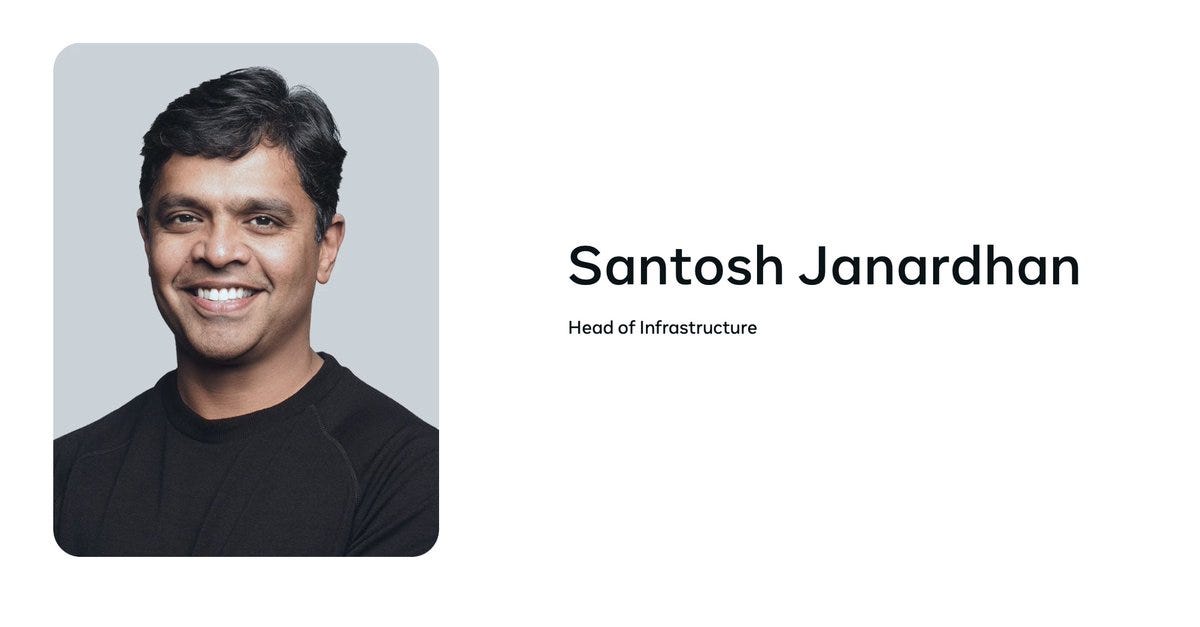
Look how Meta’s own blog introduces Santosh.
“At an organization as vast and complex as Meta, it’s hard to ascribe too much importance to any single executive. But it seems fair to say that there are few individuals as crucial to the company’s daily operations as Santosh Janardhan. Appointed head of infrastructure last year, Janardhan is Meta’s top engineering leader, responsible for developing and operating the hardware, network, software, and data centers that all Meta’s services run on. That means keeping everything humming for the more than 3.7 billion people who use Meta’s family of apps each month, while simultaneously laying the groundwork and vision for a highly advanced AI infrastructure to power the company’s products of today and tomorrow”
Later in the article, it then says...
Santosh: We have 21 owned and operated data center regions — each with multiple data center buildings the size of approximately four football fields put back to back. These structures are full of servers. So we have millions of servers, hundreds of thousands of miles of fiber optics. We also have an edge network — that helps extend our infrastructure in places where we don’t have data centers. And all of this is interconnected.
Of course, one of the challenges of operating at hyperscale is managing the inevitable outages and technical issues. The goal is to ensure that the people using our services never experience them. Day in and day out, billions of people use our products. And they’re not just using them nominally. This is how they connect with their loved ones, how they make their living, where they turn to communicate and coordinate services during emergencies. We’re the only hyperscaler that is not a public cloud.”
This line is fascinating.. “We’re the only hyperscaler that is not a public cloud.” We’ll be watching that closely.....
I think he’s a great candidate. Though, would be nice for them to have someone from AWS early days.
Board of Directors
The board includes Marc Andreessen, Patrick Collison (Stripe), John Elkann (Exor/Ferrari), Drew Houston (Dropbox), and Robert Kimmitt (lead independent director, ex-Deputy Treasury Secretary).
On the share register, Ackman (~9–10% of Pershing Square), Druckenmiller, Norges Bank, JPMorgan, and the passive giants (Vanguard ~8.8%, Fidelity ~6%, BlackRock ~5%) have all been buyers.
Financial Picture
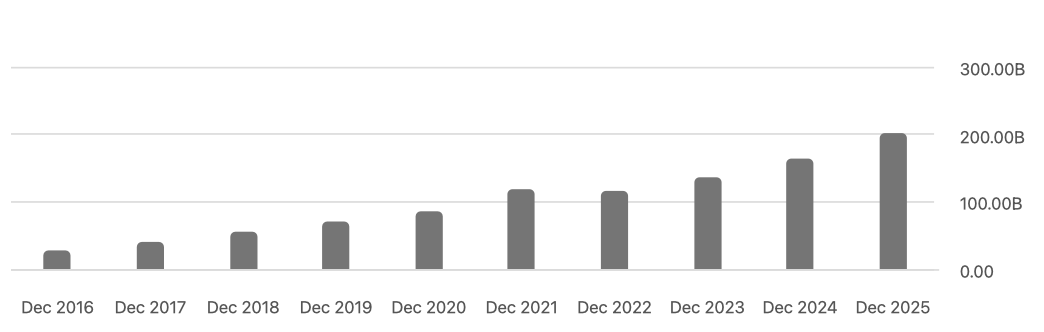
^^REVENUE
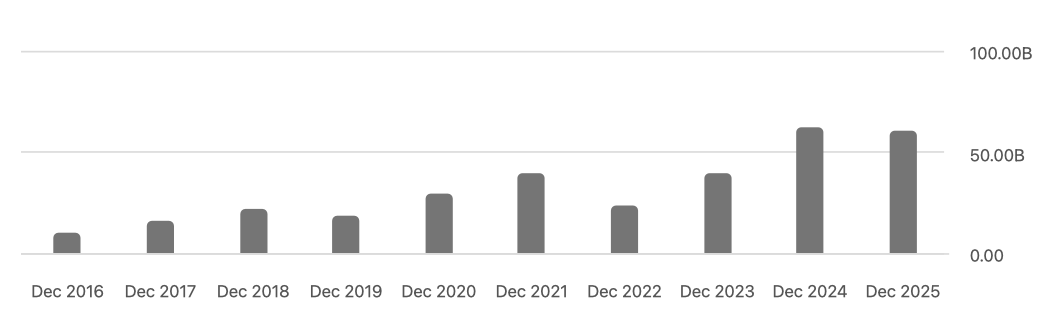
^^NET INCOME
Net Income is distorted by one-time tax implications, so we’ve normalized those out:
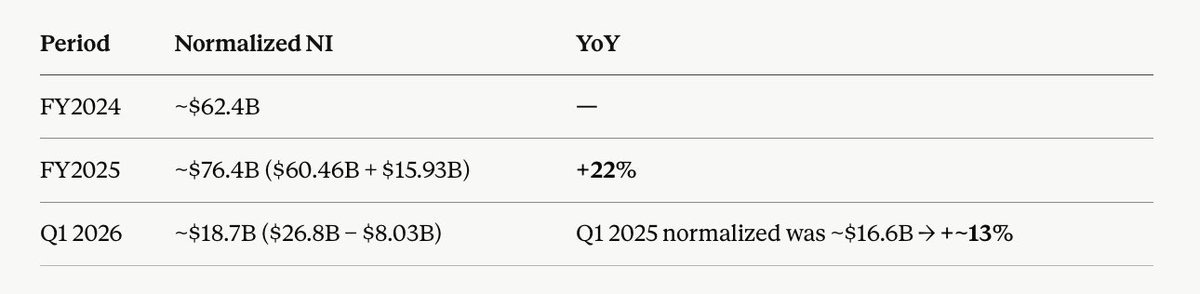
That means, we need Meta to continue to accelerate YoY growth up from that 13% to maybe 17% over the next 3 quarters if they really are going to blow the top off of NI.
Considering their Revenue grew 33% YoY for Q1.... and they’re guiding roughly the same for Q2....
Q2 2026 revenue guidance: $58–61B
...it seems plausible they grow revenue 20-30% this year, and Net Income 15%+ as well. Given all the CapEx spend, those would both be HIGHLY encouraging to see in a ‘down year.’
((Random thought... Not betting anything on these, but they really did truly do a great job with the marketing for Meta Rayban))
Sell Triggers & Thesis Breaks
We buy wonderful businesses and hold for as long as we can; we sell only when the thesis breaks, and trim only if the multiple gets absurd. Specific breakers to watch:
Capex without returns. And no Cloud layering.
The AI strategy proves wrong.
A structural ad shock.
Litigation goes systemic.
Framing Quotes, and Whether They Actually Apply
“Reversion to the mean constitutes the most powerful force in financial markets.” — Jeremy Grantham
How it applies: This is the thesis in one line. Meta’s whole history is reversion: 2022 crushed it, then margins and the multiple snapped back; today AI-capex fear has it ~22% off highs and near its average P/E (below it, adjusted). If the business keeps compounding and the fear fades, the multiple reverts up — the “out of style → back in style” pattern we’re explicitly buying.
But it might not be true. Reversion cuts both ways. Maybe the ~28–33x peaks were the anomaly and ~20x is the new normal for a maturing, ad-concentrated, capex-heavy business facing real legal and AI risks. The “mean” it reverts toward might be lower than the one we’re anchoring to — and a permanently higher capex base would justify that.
“The main thing to do is find wonderful businesses, buy them, and sit there.” — Warren Buffett
How it applies: Meta clears the “wonderful business” bar by almost any measure: 82% gross margins, 3.58B daily users, the deepest data moat in tech, and pricing power (impressions and price both rising). Founder-led, fortress cash generation, bought at a fair-to-good price — this is a sit-on-your-hands compounder, not a trade.
But it might not be true. “Sit there” only works if the moat is durable. And if I can actually hold on. If AI assistants replace the social feed as how people consume information, or if the frontier-model bet fails, Meta’s attention-and-data moat could erode faster than its 20-year history implies. We’ve never actually seen the feed disrupted; we’re trusting it won’t be on Zuckerberg’s watch.
Value?
$1.55T market cap
$125B cash from ops
$70-80B of owner earnings
19-21x O.E. Multiple
Roughly 5% OE Yield, growing 30% rev, engagement of products also expanding quickly.. and the wild card that puts this over the top would be a successful Cloud business.
They have $240B Equity, about 28% historical ROIC, and are pumping all cashflows back into CapEx. We should see an expanded ROIC if they do cloud correct given the Big 3 all have operating margins above 30%. And Meta could over deliver considering how well AI is working to ad’s already.
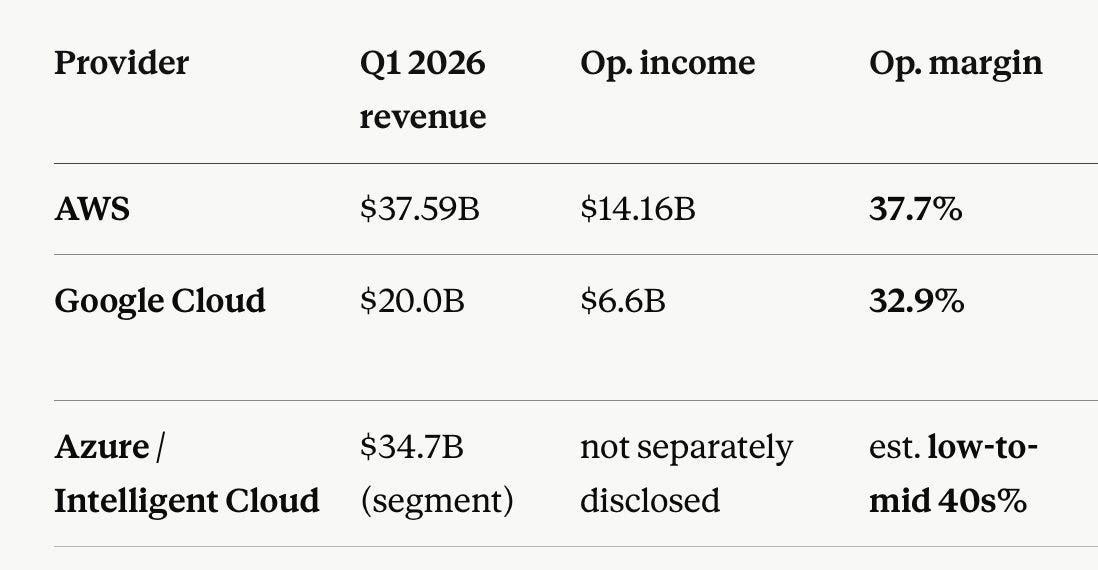
I’m optimistic about Meta’s ROIC if they end up monetizing these datacenter with a mix of Cloud and Meta AI... but we need to watch next earnings closely.
Don
Www.LinkedIn.com/in/donstein
https://x.com/donversationz